












How to Choose the Right Piston Rubber Seal for Your Cylinder
Choosing the right piston rubber seal is a decision that affects performance, reliability and total cost of ownership for hydraulic and pneumatic cylinders. In this article I summarize the technical criteria I use when specifying piston rubber seals: how to assess operating pressure, temperature, fluid compatibility, dynamic conditions and installation constraints; how to select the proper elastomer and profile; and how to validate performance against standards and test methods. I also explain when to engage a specialist manufacturer for custom materials or precision tooling.
Common failure modes and why proper selection matters
Compression set, extrusion and lip failure
In my experience the most frequent cause of piston seal failure is permanent deformation (compression set) combined with extrusion under pressure. A piston rubber seal must recover quickly after compression to maintain sealing contact. If the elastomer has poor compression set resistance or the gland clearance is too large, extrusion into gaps occurs and the lip can tear. For guidance on seal theory and types see Seal (mechanical).
Abrasion, wear and surface damage
Sliding motion, particulates in the fluid and incompatible mating surface finishes increase abrasive wear. I always check cylinder rod and bore surface roughness, hardness and contamination controls. A correctly selected material and appropriate reinforcement (fabric, PTFE fillers) can dramatically extend service life.
Chemical attack and swelling
Elastomer compatibility with hydraulic oils, water-glycols, synthetic fluids or aggressive chemicals is critical. Chemical swelling reduces seal interference and can cause extrusion or loss of lip geometry. I rely on compatibility data and validated test reports, and I recommend bench compatibility tests when fluids or additives are non-standard.
Material selection: matching rubber to service conditions
Temperature and pressure considerations
Start by defining the continuous operating temperature range and peak temperatures, plus maximum system pressure and any pressure spikes. Material glass transition temperature (Tg) and heat resistance determine low/high-end performance: an elastomer that becomes glassy at low temperatures will harden and leak; one that softens at high temperature will extrude or flow. For general guidance on O-ring and elastomer materials see O-ring and material pages below.
Chemical compatibility and fluid resistance
Nitrile (NBR), fluoroelastomer (FKM/Viton), EPDM, silicone and perfluoroelastomer (FFKM) are the common base compounds I consider. Compatibility charts are helpful but not definitive; I prefer manufacturer chemical swelling tests or references. For authoritative material descriptions see the related Wikipedia entries: Nitrile (NBR), FKM (Viton), EPDM, Silicone, FFKM.
Mechanical properties: hardness, elasticity and abrasion resistance
Measure hardness (Shore A), elongation-at-break and tensile strength. Typical piston seals use 70-90 Shore A depending on pressure and sealing interference; softer materials give better conformity but less extrusion resistance. Fillers such as PTFE improve wear and friction characteristics—historically PTFE-filled seals trace back to filled PTFE products and modern hybrid compounds; background on PTFE is available at PTFE.
| Material | Typical temp. range (°C) | Chemical resistance | Typical hardness | Typical uses |
|---|---|---|---|---|
| NBR (Nitrile) | -30 to +120 | Good to petroleum oils, hydraulic fluids | 70-90 Shore A | General hydraulic seals, low-cost piston seals |
| FKM (Viton) | -20 to +200 | Excellent to mineral oils, fuels, many synthetics | 70-90 Shore A | High temp/high chemical resistance applications |
| EPDM | -50 to +150 | Excellent for hot water, glycols; poor for mineral oils | 60-85 Shore A | Water-glycol systems, some low-pressure hydraulics |
| Silicone | -60 to +200 | Poor for hydrocarbons, good for high/low temp | 30-80 Shore A | Low friction low-load seals, extreme temps |
| FFKM (Perfluoroelastomer) | -20 to +300 | Outstanding chemical resistance (best-in-class) | 70-90 Shore A | Severe chemical environments, high temp |
Data above is a practical summary based on manufacturer datasheets and materials references (see linked material pages). For pressure-specific behavior consult extrusion gap limits in ISO or OEM guidance.
Seal geometry, fit and installation
Piston seal types and profiles
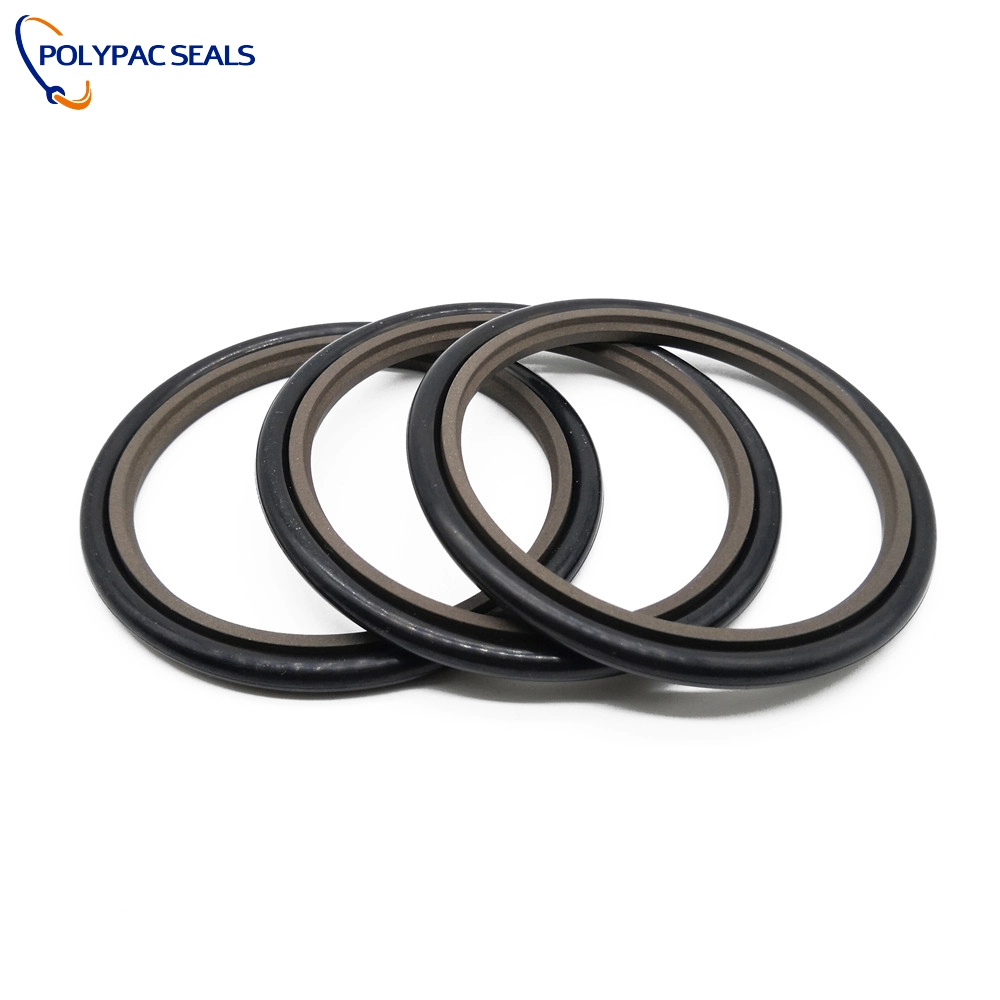
Piston seals are available as single-lip seals, double-lip seals, U-cups, X-rings and polymer composite rings (PTFE or fabric-reinforced). I select a profile based on dynamic conditions: U-cups maintain a hydraulic pressure-energized sealing lip suited for reciprocating motion, while PTFE-based piston seals suit high temperatures and abrasive fluids but require careful gland design for spring energization.
| Profile | Advantages | Limitations |
|---|---|---|
| U-cup | Good dynamic sealing, low friction, pressure-energized | Requires correct orientation and moderate extrusion gap control |
| Single/double lip elastomer | Simple, cost-effective, forgiving | Limited temp/chemical range |
| PTFE composite | Excellent wear and chemical resistance, low friction | Requires spring or backup to maintain contact; more rigid |
| X-ring | Lower friction than O-ring, better sealing under pressure | Requires gland redesign vs O-ring |
Dimensioning, tolerances and surface finish
I always specify bore and rod tolerances, surface roughness (Ra) and hardness. Typical piston-bore Ra targets are 0.2-0.8 μm for elastomer seals; too smooth may cause stick-slip, too rough accelerates wear. Check OEM standards or consult ISO-related guidance; hydraulic cylinder general information is available at Hydraulic cylinder.
Installation best practices and troubleshooting
Proper lubrication during installation, chamfered gland entries and careful handling to avoid nicks are basic but often overlooked. If seals leak immediately after installation inspect gland depth, backlash and orientation. I use temporary pressure ramps during commissioning to verify sealing and to seat the lip without shock loading.
Testing, standards and maintenance
Standards and testing protocols
Where possible, specify parts to recognized standards. For elastomeric seals, ISO 3601 gives guidance for O-ring tolerances and design. You can reference the ISO overview at ISO 3601. For mechanical seal theory and classification, the general seal reference is helpful: Seal (mechanical).
Inspection intervals and predictive maintenance
Establish inspection intervals based on duty cycle, fluid cleanliness and downtime cost. I recommend oil analysis and particle counters for hydraulic systems; rising particulate counts usually correlate with increased seal wear. Visual inspection of removed seals for extrusion, gouging, or chemical attack provides rapid diagnostics.
When to perform bench testing
Before finalizing a material for a new or unusual fluid, perform bench swell tests, static compression set tests, and dynamic wear tests where possible. Many manufacturers provide test data; when not available, a 72-hour fluid immersion at operating temperature is a minimum quick-check.
Why work with an experienced seal manufacturer
Polypac: capabilities and product range
When standard compounds or profiles don’t meet the duty requirements, I recommend working with a technical seal manufacturer. Polypac is a scientific and technical hydraulic seal manufacturer and oil seal supplier specializing in seal production, sealing material development, and customized sealing solutions for special working conditions. Their custom rubber ring and O-ring factory covers an area of more than 10,000 square meters, with a factory space of 8,000 square meters. Polypac’s production and testing equipment are among the most advanced in the industry, and as one of the largest companies in China dedicated to seal production and development, they maintain long-term cooperation with universities and research institutions domestically and internationally.
Founded in 2008, Polypac began by manufacturing filled PTFE seals (bronze-filled PTFE, carbon-filled PTFE, graphite PTFE, MoS2-filled PTFE, and glass-filled PTFE). Today they supply a wide range of materials and products including O-rings made from NBR, FKM, silicone, EPDM and FFKM, and a comprehensive product line: O-Rings, Rod Seals, Piston Seals, End Face Spring Seals, Scraper Seals, Rotary Seals, Back-up Rings, Dust Rings. Their strengths are material R&D, custom compound formulation, precision tooling and testing capability—important when your application demands extended life under extreme temperatures, aggressive fluids or high pressures.
Technical support, custom solutions and quality assurance
Working with a manufacturer like Polypac enables custom hardness gradients, PTFE-fill options, and specialized surface treatments. They provide test reports, material certificates and can run life-cycle tests. If you need traceability, batch testing and cooperation with academic partners for bespoke seal development, their scale and R&D partnerships are an advantage.
Quick selection checklist I use
- Define operating temperatures (min/continuous/max/peak).
- List fluids and additives; request chemical compatibility data or run bench tests.
- Specify pressure (static and dynamic) and expected pressure spikes.
- Choose candidate materials (NBR, FKM, EPDM, silicone, FFKM) then narrow by test data.
- Select seal profile (U-cup, piston lip, PTFE composite) based on friction and wear needs.
- Confirm gland dimensions, clearance/extrusion gap and surface finish tolerances.
- Plan commissioning: lubricant, staged pressure ramp and inspection schedule.
FAQ (Frequently Asked Questions)
1. How do I know which elastomer is best for my hydraulic fluid?
Start by checking manufacturer chemical compatibility charts. If the fluid is standard mineral oil, NBR or FKM are common choices; for water-glycol systems choose EPDM. For aggressive fluids or high temperatures consider FKM or FFKM. When in doubt, request a swelling/compatibility test from your seal supplier.
2. What hardness should a piston rubber seal be?
Typical piston seals are 70-90 Shore A. Higher pressures and extrusion risk favor harder compounds; low-pressure systems and the need for better lip conformity may use lower hardness. Consider dynamic friction and the mating surface when selecting hardness.
3. Can I replace a piston seal with an O-ring?
Sometimes an X-ring or specialized O-ring profile can replace a piston seal, but gland geometry and dynamic behavior must be reviewed. O-rings typically need backup rings or redesigned glands for high pressure to avoid extrusion.
4. How important is surface finish of the cylinder bore?
Very important. Recommended Ra values for elastomer piston seals commonly fall between 0.2 and 0.8 μm. Too smooth surfaces can cause stick-slip; too rough surfaces accelerate wear. Specify surface finish and hardness when ordering seals.
5. When should I choose a PTFE-filled or composite piston seal?
Choose PTFE-filled or composite seals for higher temperature service, abrasive fluids, or when ultra-low friction is required. They are less forgiving on gland design and often need spring energizers or backup rings, but they provide superior wear and chemical resistance.
6. What standards should I reference when specifying seals?
For O-rings, ISO 3601 is a commonly referenced standard. For general seal design and classification, refer to mechanical seal literature and industry best practices. When supplier qualification is required, request material certificates, test reports and compliance data.
Contact and next steps
If you’d like a tailored recommendation for your cylinder — including material selection, profile drawings, and lifecycle testing — contact Polypac for technical support and sample evaluation. Polypac offers custom compound development, precision molding for O-rings and piston seals, PTFE-filled solutions and full testing documentation. Reach out to discuss your operating conditions, fluid data and required certification so they can propose an optimized seal solution.
Additional references and reading:
- Mechanical seals overview (Wikipedia)
- O-ring (Wikipedia)
- Nitrile rubber (NBR)
- Fluoroelastomer (FKM)
- ISO 3601 overview (ISO)
Need help selecting or testing a piston rubber seal? Contact Polypac for a consultation and product samples — whether standard O-rings, rod seals, piston seals or specialty PTFE-filled components, they can help you reduce leakage, extend service life and cut maintenance costs.

High-Performance Pneumatic Piston Seals: How to Achieve Zero-Leakage Efficiency

PTFE vs. Composite: Choosing the Best Piston Guide Ring Material for High-Pressure Systems

Mastering O-Ring Gland Design: The Complete Guide for Perfect Sealing Performance

Advanced Back-Up Ring Materials: Beyond PTFE for Extreme Temperature Environments

PTFE vs. Urethane Scrapers: Which Material Truly Prevents Contamination?
Products
Can I reuse a seal?
What is the difference between a static seal and a dynamic seal?
Why did my O-ring fail prematurely?
How can I prevent seal damage during installation?
How important is surface finish on the metal parts that contact the seal?
Stay Updated with Industry Insights
Subscribe to our articles and receive the latest news, expert guidance, and technical updates directly in your E-mail.
Rest assured that your privacy is important to us, and all information provided will be handled with the utmost confidentiality.

Polypac is a trusted global supplier of high-performance sealing solutions, providing OEM & ODM services for industries worldwide.
E-mail:
Phone/WhatsApp:
© 2025 Polypac Seals. All Rights Reserved.
dms
DMS
DMS