












How to Choose the Right Piston Seal: Buyer’s Guide
Piston seals are critical components in hydraulic and pneumatic cylinders: they convert fluid pressure into controlled linear motion while preventing leakage, minimizing friction, and ensuring service life. Choosing the right piston seal requires understanding operating conditions, seal profile and material properties, dimensional tolerance and installation methods, and applicable standards. This guide helps engineers, maintenance managers, and procurement specialists evaluate options, compare materials and seal types, and select suppliers capable of delivering reliable, optimized sealing solutions for specific working environments.
Understanding piston seal fundamentals
What piston seals do and why they matter
Piston seals separate the high-pressure chamber from the low-pressure side inside a cylinder, converting fluid power into mechanical force. Poor selection results in leakage, reduced efficiency, heat generation, accelerated wear, and potential equipment failure. For background on hydraulic sealing principles, see the general overview on Hydraulic seal - Wikipedia.
Key performance requirements
When selecting piston seals, prioritize: sealing efficiency (leakage rate under pressure), friction (breakaway and running), wear resistance, chemical compatibility, temperature stability, pressure capacity, and dimensional stability. The correct balance depends on whether the application is hydraulic vs. pneumatic, reciprocating vs. oscillating, and the desired maintenance interval.
Common failure modes and diagnostic clues
Recognizing failure types helps choose the right design or material. Common modes include extrusion (seal pushed into clearance gaps), thermal degradation (hardening or cracking due to heat), chemical attack (swelling or softening), abrasive wear (surface scoring from contaminants), and compression set (loss of sealing force over time). Visual inspection, leakage patterns, and operational data (temperature, pressure cycles) pinpoint the root cause and guide corrective selection.
Material selection: matching chemistry and environment
Overview of common seal materials
Material choice is often the decisive factor. Typical options for piston seals include polyurethane (PU), nitrile rubber (NBR), fluoroelastomer (FKM/Viton), silicone (VMQ), EPDM, PTFE (and filled PTFE blends), and high-performance FFKM. Each material brings trade-offs in temperature range, chemical resistance, wear, and cost.
Material properties comparison
The table below summarizes typical operating ranges and advantages. Data compiled from material references and manufacturer datasheets (see references such as the material pages on Nitrile rubber, Fluoroelastomer, and PTFE).
| Material | Typical Temp Range (°C) | Strengths | Limitations |
|---|---|---|---|
| Polyurethane (PU) | -30 to 80 | Excellent wear & tear resistance; high tear strength | Limited high-temp and chemical resistance |
| Nitrile (NBR) | -40 to 120 | Good oil resistance; economical | Poor ozone and weathering resistance |
| Fluoroelastomer (FKM) | -20 to 200 | Excellent high-temp and hydrocarbon resistance | Higher cost; limited low-temp flexibility |
| PTFE (and filled PTFE) | -200 to 260 | Outstanding chemical and temp resistance; low friction | Low elasticity; may require spring energizer or backup |
| Silicone (VMQ) | -60 to 200 | Excellent temp range & flexibility | Poor mechanical wear resistance; limited hydraulic oil compatibility |
Sources: material summaries on Wikipedia and industry datasheets (see links above and manufacturer technical literature).
How to match material to fluid and temperature
Start by listing operating fluid, max/min temperatures, contaminants, and required service life. For petroleum-based hydraulic oils, NBR or FKM are common; for high temperature or aggressive fluids, FKM or PTFE blends are preferred. For abrasive environments where wear is dominant, PU or filled PTFE with a robust energizer can be optimal.
Seal profile, design & dimensional considerations
Profile types and when to use them
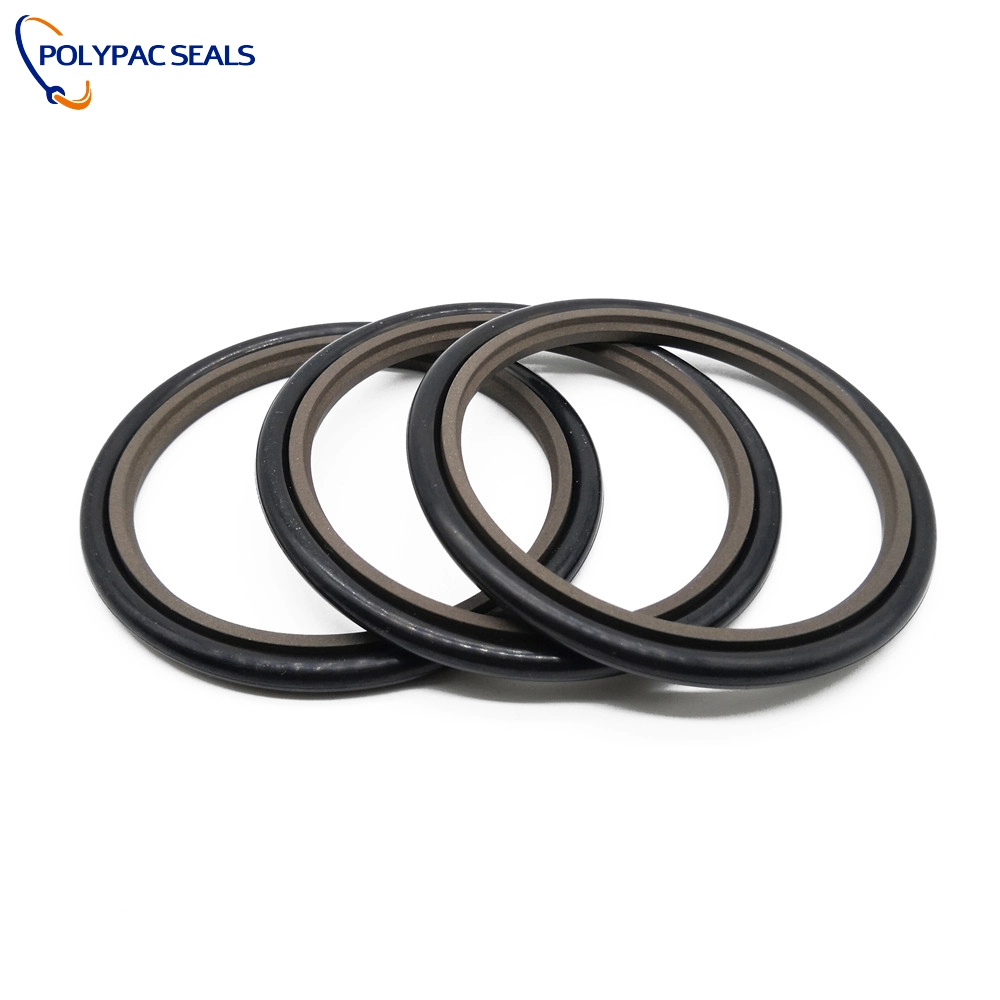
Piston seal profiles include U-cups, V-rings, square rings, piston rings (metal with elastomeric coating), and PTFE composite rings. U-cup seals are common in hydraulic cylinders due to low friction and good dynamic sealing. PTFE composite piston seals excel in high-temperature or chemically aggressive environments but often need energizing springs or O-rings to maintain sealing contact.
Clearance, tolerance and extrusion control
Seal effectiveness depends on proper gland dimensions and rod/cylinder clearances. Excessive clearance invites extrusion and rapid failure. Use manufacturers' recommended tolerances for groove dimensions and consider back-up rings (anti-extrusion rings) where pressure and clearance create risk. Industry references such as seal design guidelines from manufacturers and standards bodies provide specific dimensional data; always validate against supplier drawings.
Friction vs. sealing trade-offs
Lower friction reduces energy losses and stick-slip but may sacrifice sealing tightness. For precision motion or low-pressure systems, choose low-friction profiles (PTFE, low durometer elastomers). For high-pressure sealing, select profiles that generate sufficient contact pressure or use energizers. When minimizing friction, also consider lubrication strategies (system oil, lubrication grooves, or PTFE facings).
Testing, standards, and lifecycle considerations
Relevant standards and testing protocols
Refer to standards for measurement and testing: O-ring dimensions are standardized under ISO 3601 (general O-ring standards) and hydraulic component testing often follows industry test protocols. For background on sealing technology and recommended practices, see the O-ring and seal overviews at O-ring - Wikipedia.
Prototype testing and field validation
Always validate material and profile choices with prototype testing that replicates pressure pulses, temperature cycles, chemical exposure, and contamination. Accelerated life testing (thermal aging, pressure cycling) and wear tests give predictive insight into service life. Record breakaway friction, steady-state friction, leakage rate, and visual wear at intervals.
Maintenance intervals and inspection checkpoints
Design for inspectability: include ports to detect internal leakage, and schedule inspections by hours of operation or cycles rather than calendar time when variability is high. Track oil contamination levels and particle counts; high particulate content requires more frequent seal replacement and may favor more wear-resistant materials or added filtration.
Choosing a supplier and customizing seals (including Polypac)
What to expect from a full-service seal manufacturer
A capable supplier should offer material expertise, dimensional engineering, prototyping, testing equipment, and the ability to produce both standard and custom seals. Look for long-term partnerships with R&D institutions and demonstrable test labs. Manufacturer whitepapers, test reports, and customer references are useful evaluation artifacts.
Polypac: capabilities, differentiation and product range
Polypac is a scientific and technical hydraulic seal manufacturer and oil seal supplier specializing in seal production, sealing material development, and customized sealing solutions for special working conditions. Polypac's custom rubber ring and O-ring factory covers an area of more than 10,000 square meters, with a factory space of 8,000 square meters. Our production and testing equipment are among the most advanced in the industry. As one of the largest companies in China dedicated to the production and development of seals, we maintain long-term communication and cooperation with numerous universities and research institutions both domestically and internationally.
Founded in 2008, Polypac began by manufacturing filled PTFE seals, including bronze-filled PTFE, carbon-filled PTFE, graphite PTFE, MoS₂-filled PTFE, and glass-filled PTFE. Today, we have expanded our product line to include O-rings made from various materials such as NBR, FKM, silicone, EPDM, and FFKM. Polypac's core product strengths include O-Rings, Rod Seals, Piston Seals, End Face Spring Seals, Scraper Seals, Rotary Seals, Back-up Rings, and Dust Rings.
Competitive differentiators:
- Strong materials R&D and access to filled PTFE technologies for demanding environments.
- Large-scale manufacturing with advanced production and testing equipment.
- Custom engineering support for special working conditions and collaborative development with research institutions.
- Comprehensive product lineup enabling system-level sealing solutions (rod, piston, rotary, and static seals).
Procurement checklist and lead-time considerations
When procuring piston seals, prepare a specification packet with: operating pressure, temperature range, fluid and contaminants, cylinder bore and rod dimensions with tolerances, expected cycles per hour, installation constraints, and target service life. Clarify whether standard catalog parts are acceptable or whether custom tooling is required—custom parts will add lead time. Ask suppliers for qualification samples and test reports; ensure traceability on material certificates for critical applications.
Practical selection workflow (step-by-step)
Step 1: Gather operating data
Collect fluid type, max/min temperatures, maximum working pressure, expected pressure spikes, speed and stroke length, particulate contamination levels, and available lubrication. This dataset dictates material and profile options.
Step 2: Narrow material and profile options
Use the gathered data to eliminate unsuitable materials (e.g., discard silicone for petroleum systems). For each candidate material, consider backup rings or energizers if the material lacks elasticity (PTFE). Compare expected wear performance and life-cycle cost, not just unit price.
Step 3: Prototype and test
Order prototypes and subject them to bench testing (pressure cycling, thermal cycling, friction tests). Validate against acceptance criteria and iterate groove/gland dimensions as needed. Field-test in controlled units before fleet-wide deployment.
Installation, troubleshooting and maintenance tips
Best practices for installation
Use correct lubrication during installation to avoid dry-run damage, inspect seals for nicks or defects prior to fitting, and ensure gland edges are chamfered to prevent cutting. For PTFE seals, pre-lubricate and use appropriate installation tools to avoid rolling or twisting.
Common troubleshooting steps
If you observe leakage or high friction, verify: correct gland dimensions, presence of back-up rings, correct material selection for fluid and temperature, and absence of scoring or particulate damage on mating surfaces. Replace worn seals and check for root causes like filtration failure or misalignment.
Monitoring and predictive replacement
Implement condition monitoring: measure leakage rates, track operating temperatures, and log cycle counts. Use these trends to trigger predictive replacements prior to catastrophic failure.
FAQ
1. What is the difference between piston seals and rod seals?
Piston seals seal between the piston and the cylinder bore and deal with differential pressures across the piston. Rod seals seal between the piston rod and housing to prevent fluid escape to the atmosphere. Each sees different motion types and contamination exposure; designs and materials vary accordingly. See general seal categories at Hydraulic seal - Wikipedia.
2. When should I choose PTFE over elastomers for piston seals?
Choose PTFE (or filled PTFE) when you need exceptional chemical resistance, very low friction, and high-temperature stability. PTFE requires special gland design or energizing elements because of limited elasticity; it's often used in high-temp, aggressive-chemical, or low-lubrication environments.
3. How do I prevent extrusion in high-pressure applications?
Use back-up rings in the gland to block extrusion paths, tighten tolerances between piston and bore, and select materials with sufficient compression resistance. Filled PTFE paired with energized O-rings or anti-extrusion rings offers a common solution.
4. What test data should vendors provide with piston seals?
Ask for material certificates, dimensional drawings, bench test reports (pressure cycling, leakage rates), accelerated aging data, and any field trial results. For critical applications, request full test protocols and witness testing if needed.
5. How often should piston seals be replaced?
Replacement intervals depend on operating conditions. High-contamination or high-cycle systems may need frequent replacements (months), while well-maintained systems with appropriate filtration can last years. Use condition monitoring (leakage, friction, particle counts) to determine replacement triggers rather than fixed calendar schedules.
6. Can I use standard seals as drop-in replacements for existing cylinders?
Sometimes—if dimensions, groove geometry, and operating conditions match. However, many legacy systems use non-standard grooves or materials. Always verify dimensional compatibility and materials suitability before assuming a direct replacement.
Contact and next steps
If you need technical support, custom prototyping, or volume supply of piston seals, Polypac can assist with material selection, custom tooling, and testing. View Polypac's product portfolio—including O-Rings, Rod Seals, Piston Seals, End Face Spring Seals, Scraper Seals, Rotary Seals, Back-up Rings, and Dust Rings—and request a quote or sample.
Contact us to discuss specific applications, request datasheets, or arrange prototype testing. For product inquiries and technical consultation, please reach out to Polypac's sales and engineering team.

High-Performance Pneumatic Piston Seals: How to Achieve Zero-Leakage Efficiency

PTFE vs. Composite: Choosing the Best Piston Guide Ring Material for High-Pressure Systems

Mastering O-Ring Gland Design: The Complete Guide for Perfect Sealing Performance

Advanced Back-Up Ring Materials: Beyond PTFE for Extreme Temperature Environments

PTFE vs. Urethane Scrapers: Which Material Truly Prevents Contamination?
Products
Can I reuse a seal?
Why did my O-ring fail prematurely?
What does "AS568" mean?
How important is surface finish on the metal parts that contact the seal?
How can I prevent seal damage during installation?
Stay Updated with Industry Insights
Subscribe to our articles and receive the latest news, expert guidance, and technical updates directly in your E-mail.
Rest assured that your privacy is important to us, and all information provided will be handled with the utmost confidentiality.
Polypac is a trusted global supplier of high-performance sealing solutions, providing OEM & ODM services for industries worldwide.
E-mail:
Phone/WhatsApp:
© 2025 Polypac Seals. All Rights Reserved.
dms
DMS
DMS