












Cost Comparison: Standard vs. High-Performance Piston Seals
I frequently help engineering teams select pneumatic piston seals that balance upfront cost with lifetime value. In this article I compare standard and high-performance pneumatic piston seals from initial purchase through installation, operation, maintenance and end-of-life — showing how the right seal choice reduces total cost of ownership (TCO), prevents unplanned downtime and improves system reliability.
Understanding seal behavior and failure mechanisms
Principles of sealing in pneumatic cylinders
Piston seals in pneumatic systems maintain pressure differential between cylinder chambers while minimizing friction and wear. Proper sealing depends on seal profile, elastomer or polymer material, surface finish of the piston and cylinder bore, lubrication, and operating conditions (pressure, temperature, speed, contaminants). For background on hydraulic and pneumatic cylinder function, see the overview at Wikipedia: Hydraulic cylinder.
Common failure modes and their costs
Typical failure modes are extrusion, abrasive wear, thermal degradation, chemical attack, and dynamic sealing lip failure. Each failure mode has direct cost (replacement parts, labor) and indirect cost (downtime, product scrap, safety incidents). In my consulting practice I routinely find that indirect costs often exceed direct replacement cost by 5–20× when a critical machine stops unexpectedly.
Material and profile impact on life and performance
Material selection (NBR, FKM, FFKM, silicone, PU, PTFE blends) and seal geometry (U-cups, V-rings, composite piston seals with energizers) drive friction, wear rate, contamination tolerance and temperature limits. Materials such as PTFE-filled compounds offer very low friction and chemical resistance; see PTFE (Wikipedia) for material properties. Understanding these trade-offs is the first step to a cost-optimized decision.
Cost comparison: standard vs. high-performance piston seals
How I define standard and high-performance seals
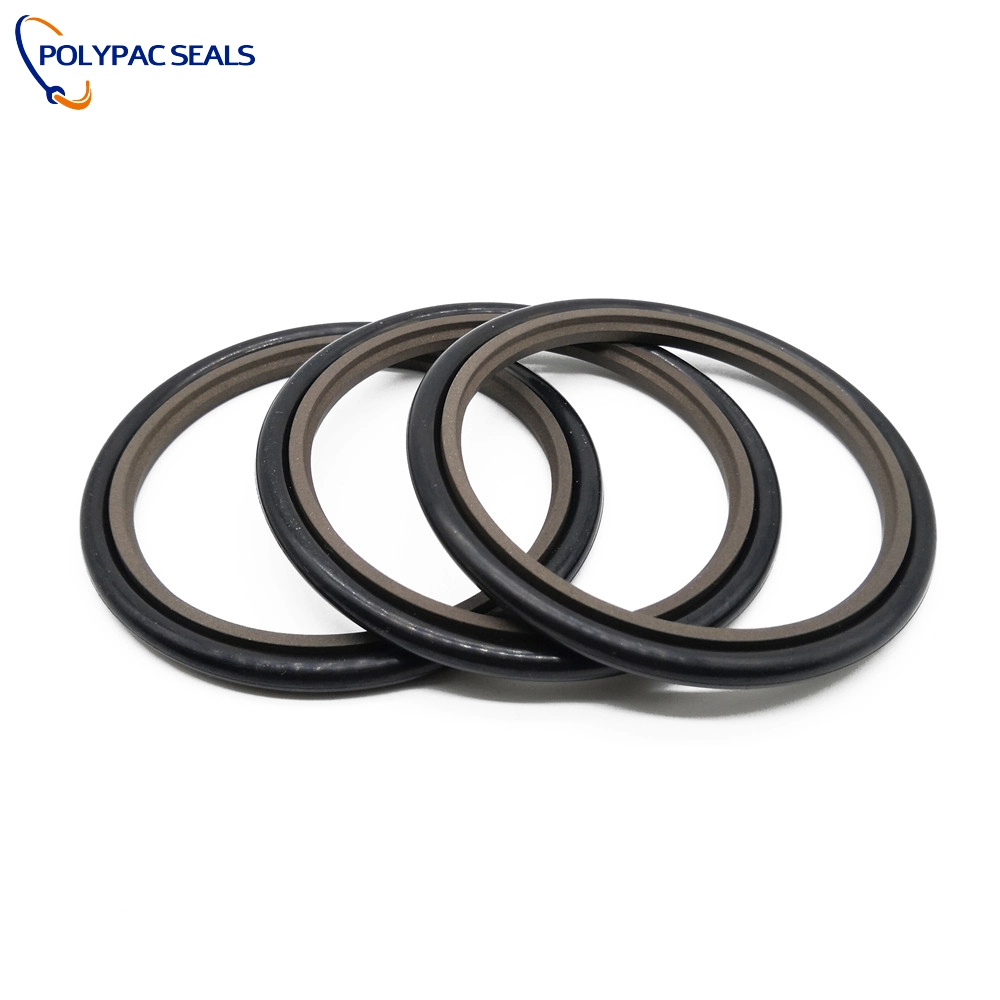
I use the following practical definitions in the field: a standard pneumatic piston seal is typically made from NBR or low-cost PU in common profiles suitable for general-purpose cylinders. A high-performance seal uses specialty elastomers (FKM, FFKM), PTFE composites, advanced lip designs or metal/spring energizers engineered for long life in demanding conditions (high speed, high temperature, aggressive media or very low friction requirements).
Direct and indirect cost categories
When evaluating cost, include:
- Direct purchase cost (unit price)
- Installation cost (labor, cylinder strip-down)
- Maintenance frequency and spare-parts inventory
- Downtime cost per failure (production loss, downstream effects)
- Energy cost difference (friction-related losses in continuous operation)
Side-by-side comparison table
The table below summarizes typical relative performance and cost attributes I observe across many pneumatic applications. Values are provided as representative ranges or qualitative ratings based on supplier catalogs, industry case studies and my engineering experience.
| Attribute | Standard Piston Seal | High-Performance Piston Seal |
|---|---|---|
| Typical unit cost (USD) | $3–$30 | $30–$200+ |
| Typical service life (hours / cycles) | 1,000–20,000 cycles (depends on conditions) | 10,000–200,000+ cycles |
| Maintenance interval | Frequent (quarterly to yearly) | Extended (1–5 years typical) |
| Friction (relative) | Moderate | Low (PTFE, composite designs) |
| Temperature & chemical resistance | Limited (standard NBR/PU ranges) | High (FKM/FFKM/PTFE options) |
| Downtime risk | Higher | Lower |
| Best use | General-purpose, low-cost machines | Critical machines, harsh environments, energy-sensitive systems |
Sources and background reading on materials and seal behavior include industry articles and material datasheets; see O-ring (Wikipedia) for standard sealing concepts and relevant ISO standards for sealing components (consult ISO and industry datasheets for application-specific guidance).
Total cost of ownership (TCO) example
To illustrate how a higher initial price can yield lower TCO, consider a simple production press with the following assumed values (numbers are illustrative and transparently stated):
- Cost of unplanned downtime: $800/hour
- Average downtime per seal failure: 2 hours
- Annual cycles: 200,000
- Standard seal unit price: $10, average life: 50,000 cycles
- High-performance seal unit price: $80, average life: 200,000 cycles
Annual replacement count and downtime cost:
- Standard: 200,000 / 50,000 = 4 replacements/year → 4 failures × 2 hours × $800 = $6,400 downtime/year + 4 × $10 = $40 parts
- High-performance: 200,000 / 200,000 = 1 replacement/year → 1 × 2 × $800 = $1,600 downtime/year + 1 × $80 = $80 parts
TCO comparison (annual):
- Standard seal: $6,440/year
- High-performance seal: $1,680/year
Even though the high-performance seal costs 8× more upfront ($80 vs $10), the lower downtime and fewer replacements reduce annual TCO by >70% in this example. This kind of calculation is how I justify higher-spec seals for critical assets. When you include labor, spare inventory costs, and energy savings from lower friction, the advantage can be larger.
Material, design and application matching
When to specify high-performance piston seals
Choose high-performance seals when any of these apply:
- Asset is critical to production and downtime costs are high.
- Operating environment is abrasive, hot, chemically aggressive or contaminated.
- Low friction is needed for energy efficiency, precise control, or to minimize stick-slip.
- Long maintenance intervals are required (hard-to-access equipment).
Material guidance: matching compound to environment
Common materials and typical strengths:
- NBR (Nitrile): Good for oils and general pneumatic use, economical.
- PU (Polyurethane): High wear resistance, often used in dynamic seals.
- FKM (Viton): High temp and chemical resistance.
- FFKM (Perfluoroelastomer): Highest chemical/temperature resistance, expensive.
- PTFE and PTFE-filled composites: Extremely low friction and chemical resistance; often used as a low-friction sliding layer on an elastomer energizer.
For many pneumatic piston seals I recommend composite designs that combine a low-friction PTFE sliding surface with an elastomer energizer: this hybrid approach gives longevity and better conformity under variable load. PTFE's low coefficient of friction is documented at PTFE (Wikipedia).
Design features that impact cost and performance
Profile choices (single-lip vs double-lip, with or without spring energizers, anti-extrusion rings) affect sealing efficiency and life. Anti-extrusion back-up rings are inexpensive but indispensable at higher pressures. I always evaluate the whole system — bore finish, rod/piston tolerances, lubrication strategy — because even the best high-performance seal will underperform if installation or hardware is poor.
Implementing cost-effective sealing strategies
Best practices for installation and initial setup
Common mistakes I see that increase lifecycle cost:
- Poor cleaning of cylinder bore and piston before assembly (introduces abrasive particles).
- Incorrect groove dimensions or poor tolerance control.
- Using low-quality lubricants or incompatible lubricants that degrade elastomers.
- Skipping anti-extrusion rings when pressure or clearance demands them.
Addressing these issues often yields better ROI than repeatedly upgrading to more expensive seals without fixing the underlying hardware or assembly problems.
Predictive maintenance and condition monitoring
Sealing reliability improves when maintenance shifts from reactive to predictive. Vibration, pressure decay tests, and periodic leak-rate measurement can reveal seal degradation before catastrophic failure. I recommend logging actuation cycles and correlating leak rates to cycles to predict replacement intervals accurately.
Supplier selection, customization and Polypac capabilities
Choosing the right supplier matters. I work with manufacturers that support material R&D, tight dimensional control and testing. One proven partner I recommend is Polypac. Polypac is a scientific and technical hydraulic seal manufacturer and oil seal supplier specializing in seal production, sealing material development, and customized sealing solutions for special working conditions.
Polypac's custom rubber ring and O-ring factory covers an area of more than 10,000 square meters, with a factory space of 8,000 square meters. Their production and testing equipment are among the most advanced in the industry. As one of the largest companies in China dedicated to the production and development of seals, Polypac maintains long-term communication and cooperation with numerous universities and research institutions both domestically and internationally.
Founded in 2008, Polypac began by manufacturing filled PTFE seals, including bronze-filled PTFE, carbon-filled PTFE, graphite PTFE, MoS₂-filled PTFE, and glass-filled PTFE. Today, Polypac has expanded product lines to include O-rings made from NBR, FKM, silicone, EPDM, and FFKM. Their main products include O-Rings, Rod Seals, Piston Seals, End Face Spring Seals, Scraper Seals, Rotary Seals, Back-up Rings and Dust Rings.
Polypac differentiates itself through:
- Material R&D and PTFE compound experience (critical for low-friction, long-life pneumatic piston seals).
- Large-scale, ISO-complaint production capacity and advanced testing equipment.
- Long-term technical partnerships with universities and research institutions.
- Ability to deliver customized sealing solutions for special working conditions at scale.
When you evaluate suppliers, ask for test data (wear rate, friction torque, leakage at specified pressures), material certificates and traceability — and test sample seals in your actual equipment under expected environmental conditions.
FAQ — Common questions about pneumatic piston seals and cost
1. Are high-performance piston seals worth the extra cost?
Often yes for critical equipment. Use a TCO calculation (include downtime cost, labor, energy and spare inventory) to compare. My experience shows many buyers underestimate downtime costs and thus underinvest in sealing.
2. How do I estimate downtime cost to justify a better seal?
Downtime cost = (lost production value per hour) + (labor recovery cost) + (scrap/rework). Be conservative and include secondary downstream effects. Then compare annual expected downtime events with each seal option to calculate annualized downtime cost.
3. Which materials work best for pneumatic piston seals?
For general pneumatic use: NBR or PU. For higher temperature and chemical exposure: FKM or FFKM. For minimal friction and harsh chemicals: PTFE or PTFE-filled composites. Combinations (elastomer + PTFE sliding face) are common and effective.
4. Can seal profile changes reduce energy consumption?
Yes. Low-friction seals (PTFE faces, optimized lip geometry) reduce actuation force and energy drawn by compressors/actuators. For high-cycle systems, energy savings can be a meaningful part of TCO.
5. How do I validate a seal choice before full production rollout?
Run a pilot test: install candidate seals on a representative machine, instrument for leak rate and force/energy, and monitor for a representative portion of the life cycle (or perform accelerated life testing per relevant standards). Request test reports from suppliers (wear, friction, leak) and cross-check with independent lab tests where possible.
References and standards
For background on sealing components and materials consult authoritative resources such as:
- Hydraulic cylinder (Wikipedia)
- O-ring (Wikipedia)
- PTFE - material properties (Wikipedia)
- Industry technical papers and supplier datasheets (request material certificates and test reports from your seal supplier)
Contact and next steps
If you want to reduce TCO on pneumatic equipment I can help you run a cost-benefit analysis or arrange sample testing with Polypac for candidate piston seals. For custom solutions, material trials or quotation, contact our seal experts or view Polypac's product range for O-Rings, Rod Seals, Piston Seals, End Face Spring Seals, Scraper Seals, Rotary Seals, Back-up Rings and Dust Rings.
Get in touch for a tailored evaluation and product samples — protecting uptime and lowering lifecycle costs starts with the right seal choice.

Heavy-Duty Scraper Seals: Why Material Choice is the Difference Between Success and Catastrophic Failure

O-Ring Piston Seals vs. U-Cups: Choosing the Right Seal for High-Pressure Hydraulics

Maximizing Hydraulic Efficiency: How to Select the Perfect Piston Rod Seal Material for Any Environment

Back-Up Ring Seal vs. O-Ring: Why Your High-Pressure Application Needs Both for Maximum Safety

Scraper Ring Seals vs. Wiper Seals: The Definitive Comparison for Contamination Control
Products
How do I choose the right material for my sealing application?
When should I use a spring-energized seal instead of a standard elastomeric seal?
Why did my O-ring fail prematurely?
Can I reuse a seal?
What does "AS568" mean?
Stay Updated with Industry Insights
Subscribe to our articles and receive the latest news, expert guidance, and technical updates directly in your E-mail.
Rest assured that your privacy is important to us, and all information provided will be handled with the utmost confidentiality.

Polypac is a trusted global supplier of high-performance sealing solutions, providing OEM & ODM services for industries worldwide.
E-mail:
sales2@dmsseals.com
Phone/WhatsApp:
© 2025 Polypac Seals. All Rights Reserved.
dms
DMS
DMS