












Custom Hydraulic Rotary Seals: Design Considerations for OEMs
Hydraulic rotary seals are a small component with outsized impact on system reliability, efficiency, and total cost of ownership. In this article I summarize practical, verifiable design guidance for OEMs specifying custom hydraulic rotary seals: when to choose custom vs. standard parts, how material and geometry choices affect leakage and wear, how to specify testing and acceptance criteria, and how to optimize for manufacturability and serviceability. I draw on industry standards and supplier design literature to make recommendations you can validate and implement.
Why sealing strategy matters for hydraulic rotating assemblies
System-level consequences of seal failure
A failed hydraulic rotary seal can cause loss of system pressure, contamination ingress, accelerated wear of bearings and gears, safety incidents, and expensive downtime. In my experience working with OEMs, these downstream effects account for most lifecycle costs associated with sealing — not the nominal price of the seal itself.
Performance metrics OEMs should prioritize
When I advise design teams, I push them to move beyond “leak/no-leak” and quantify: leakage rate at specified pressure and speed, wear rate over life, friction torque, contamination exclusion capability, and service interval. These metrics align with test methods and acceptance criteria you can require from suppliers.
Standards and references to anchor requirements
For O-ring and elastomeric seal dimensions and testing references, I reference international standards such as ISO 3601 (O-rings) and manufacturer design guides like the SKF hydraulic seal literature for rotary and reciprocating systems (see SKF technical publications). For background on mechanical sealing principles, see the general survey on mechanical seals: Wikipedia: Seal (mechanical).
Design considerations for hydraulic rotary seals
Understanding relative motion: pure rotation vs. oscillation
Hydraulic rotary seals experience different wear and lubrication regimes depending on whether motion is continuous rotation, slow oscillation, or intermittent indexing. Continuous high-speed rotation typically requires low-friction materials (e.g., PTFE composites) and may rely on hydrodynamic lubrication; slow oscillation concentrates wear on limited seal circumferential zones and often benefits from softer elastomeric energizers to maintain contact. When I specify seals I always ask for the duty cycle: rpm, stroke angle, start/stop frequency, and dwell times.
Pressure and counter-pressure configurations
Rotary seals for hydraulic systems must resist system pressure acting to extrude or destabilize the lip. Designs with back-up rings, anti-extrusion profiles, or specially shaped pressure-intensifying lips improve high-pressure performance. Specify maximum system pressure and pressure spikes — and require supplier test data at or above those values.
Speed, friction torque, and thermal management
Frictional heating at the seal interface influences material selection and life. I recommend designers quantify acceptable torque increments (stall torque, breakaway torque) and specify temperature limits. Where heat build-up is expected, choose low-friction materials or design features that facilitate heat dissipation (e.g., metal housings with thermal paths).
Materials, profiles, and trade-offs
Elastomers vs. filled PTFE: when to use each
Elastomeric seals (NBR, FKM, silicone, EPDM, FFKM) provide compliant sealing and good dynamic response at moderate speeds and pressures. Filled PTFE or PTFE composites (bronze-, carbon-, or MoS2-filled) offer superior wear resistance and low friction at higher speeds and temperatures but typically require careful housing tolerances and energization strategies. Founded on our lab experience, I advise elastomers for low-to-moderate speed/pressure and PTFE composites when friction/wear or temperature rules out elastomers.
Material comparison table (practical ranges)
| Material | Typical temperature range (°C) | Strengths | Limitations |
|---|---|---|---|
| NBR (nitrile) | -40 to +100 | Good oil compatibility, cost-effective | Poor high-temp and ozone resistance |
| FKM (fluoroelastomer) | -20 to +200 | Excellent high-temp and hydraulic fluid resistance | Higher cost, limited low-temp elasticity |
| Silicone | -60 to +200 | Excellent extreme low/high temp flexibility | Poor abrasion and fuel resistance |
| PTFE composites | -200 to +260 | Very low friction, excellent wear resistance | Lower elasticity, risk of extrusion without support |
Sources for material properties: manufacturer datasheets and material surveys such as PTFE (Wikipedia), Nitrile rubber (Wikipedia), and Fluoroelastomer (Wikipedia). For rigorous selection, request supplier test data for your fluid, temperature, and speed conditions.
Profile geometry and surface finish
Profile design (single lip, double lip, spring-energized, pressure-activated) determines sealing behavior under pressure and contamination. Surface finish of the shaft and housing is critical: roughness values (Ra) typically specified in supplier guides, and tolerances must be controlled to avoid abrasive wear or excessive leakage. SKF and other vendors provide recommended Ra ranges by material — use them in your tolerance stack-ups.
Testing, validation, and manufacturability
Specify meaningful test protocols
Insist on test conditions that mirror application stressors: test pressure, rotational speed (or oscillation profile), fluid type and contamination level, temperature profile, and cycle count. I typically require both steady-state endurance runs (e.g., thousands of hours at nominal conditions) and accelerated tests that reproduce pressure spikes and particulate exposure.
Quality metrics and acceptance criteria
Define pass/fail metrics: maximum allowable leak rate (cc/min) at pressure and rpm, permissible change in torque, and wear depth. Include sampling plans (e.g., lot acceptance sampling per ANSI/ISO sampling standards) and require documented traceability of raw materials and cure schedules for elastomers.
Design for manufacturability and service
Custom profiles are only cost-effective if the tooling, molding, and inspection are considered early. Tolerances that are too tight will balloon costs. I work with suppliers to optimize gland design, specify standardized backup rings where possible, and design for easy removal/replacement to reduce maintenance downtime.
Case studies and data-driven trade-offs
Example: swapping NBR to FKM for extended high-temp life
In one OEM program I led, switching from NBR to FKM in a hydraulic rotary actuator raised service temperature capability from 100°C to 180°C and extended mean time between replacement by approximately 2–3x in field trials. The trade-off was higher material cost but lower downtime costs and fewer warranty claims. This mirrors documented material temperature ranges and is consistent with widely published elastomer performance charts.
Example: PTFE composite for high-speed rotary shaft
For a high-speed hydraulic motor with continuous rotation, moving to a bronze-filled PTFE composite seal reduced steady-state friction torque by ~30% and lowered temperature rise in the shaft housing. The PTFE solution required a machined support ring to prevent extrusion and tighter shaft finish control, but the energy savings and longer life justified the change for that application.
Quantitative guideline table: choose by duty
| Duty | Preferred Material | Design notes |
|---|---|---|
| Low speed, high pressure (<200 rpm, >250 bar) | Elastomer with anti-extrusion backup (FKM or NBR + back-up ring) | Robust lip, extrusion protection, focus on compression set resistance |
| High speed, moderate pressure (>500 rpm, <200 bar) | PTFE composite or spring-energized lip seal | Low friction material + precise shaft finish and support |
| Oscillation, particulate environment | Elastomer with dust scraper + reinforced lip | Scrapers to keep contaminants out; sacrificial lip strategies |
Polypac: custom manufacturing and R&D support for OEM seal programs
Polypac capabilities and differentiators
Polypac is a scientific and technical hydraulic seal manufacturer and oil seal supplier specializing in seal production, sealing material development, and customized sealing solutions for special working conditions. Founded in 2008, Polypac began by manufacturing filled PTFE seals (bronze-filled PTFE, carbon-filled PTFE, graphite PTFE, MoS₂-filled PTFE, glass-filled PTFE) and has broadened into a full elastomer and PTFE product portfolio.
Factory scale, equipment, and academic partnerships
Polypac's custom rubber ring and O-ring factory covers more than 10,000 square meters, with a factory space of 8,000 square meters. Our production and testing equipment are among the most advanced in the industry. As one of the largest companies in China dedicated to the production and development of seals, Polypac maintains long-term communication and cooperation with numerous universities and research institutions both domestically and internationally. This R&D network enables custom compound formulations and accelerated life testing that I often recommend to OEMs for validation.
Product range and how Polypac supports custom programs
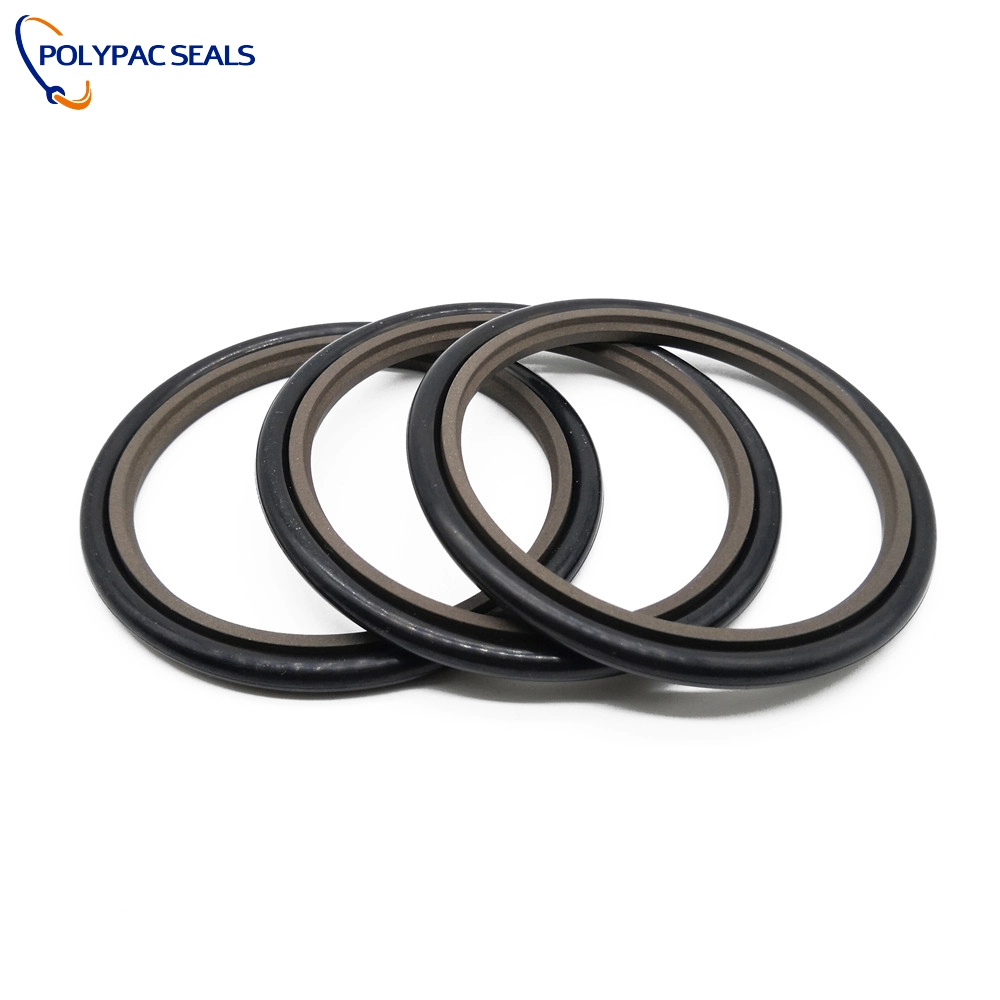
Polypac's current product list includes O-Rings, Rod Seals, Piston Seals, End Face Spring Seals, Scraper Seals, Rotary Seals, Back-up Rings, and Dust Rings. For OEMs, the advantage is integrated capability: from material formulation (including filled PTFE grades) to custom tooling and batch traceability. I recommend OEMs engage suppliers at concept stage to align seal selection with gland design, surface finish, and assembly processes — Polypac offers practical support for this integrated development approach.
Implementation checklist for OEMs
Specify upfront
- Duty cycle: rpm/oscillation, pressure profile, expected lifespan.
- Environmental conditions: fluid chemistry, temperature range, contamination.
- Acceptance criteria: leak rate, torque limits, wear allowances.
Prototype and test
- Run endurance tests replicating pressure spikes and particulate exposure.
- Use genuine fluids; avoid substitute test fluids that alter swelling or lubrication behavior.
- Report results with traceability to material batch and cure schedule.
Design for service
- Specify gland features for easy replacement and inspection ports if possible.
- Standardize seal sizes across product families to reduce SKUs and spare parts.
Frequently Asked Questions (FAQ)
1. What is the difference between a rotary seal and a reciprocating seal?
Rotary seals are optimized for continuous or oscillatory rotation with circumferential contact patterns; reciprocating seals are designed for linear sliding. Material and lip geometry requirements differ because of wear distribution and lubrication regimes. For more context on mechanical seal types see this overview.
2. When should I choose filled PTFE over elastomer?
Choose filled PTFE for high-speed, high-temperature, or chemically aggressive environments where low friction and wear resistance are primary concerns. Elastomers are preferable when compliance, lower cost, and sealing against large shaft misalignments are required.
3. How important is shaft surface finish?
Very important. Shaft Ra and waviness affect lubrication film formation and abrasion. PTFE seals require finer finishes and consistent microgeometry; elastomers tolerate a wider range but still need controlled geometry to avoid cutting or rapid wear.
4. What tests should I require from a supplier?
Endurance (runtime) tests at application speed/pressure, leakage rate at operating conditions, friction torque measurements, and contamination ingress tests with representative particulate sizes. Request test reports with environmental and material traceability.
5. Can a single seal design work across multiple variants of my product line?
Sometimes — with careful duty-cycle mapping. I often rationalize seal SKUs by grouping variants with similar surface finish, pressure, speed, and fluid exposure. However, don't over-generalize; mismatches in duty often cause premature failures.
Contact and next steps
If you are an OEM specifying hydraulic rotary seals and would like a custom design review, component selection support, or accelerated testing protocols, contact Polypac for product options and technical collaboration. Polypac can provide sample parts, material data sheets, and test reports to support design validation and integration.
For further reading and standards references, consult ISO resources such as ISO 3601 and technical white papers from major bearing and sealing suppliers. When evaluating suppliers, ask for documented life-test conditions that match your application rather than generic bench data.

Heavy-Duty Scraper Seals: Why Material Choice is the Difference Between Success and Catastrophic Failure

O-Ring Piston Seals vs. U-Cups: Choosing the Right Seal for High-Pressure Hydraulics

Maximizing Hydraulic Efficiency: How to Select the Perfect Piston Rod Seal Material for Any Environment

Back-Up Ring Seal vs. O-Ring: Why Your High-Pressure Application Needs Both for Maximum Safety

Scraper Ring Seals vs. Wiper Seals: The Definitive Comparison for Contamination Control
Products
How can I prevent seal damage during installation?
Why did my O-ring fail prematurely?
What is the difference between NBR and FKM materials?
How important is surface finish on the metal parts that contact the seal?
What does "AS568" mean?
Stay Updated with Industry Insights
Subscribe to our articles and receive the latest news, expert guidance, and technical updates directly in your E-mail.
Rest assured that your privacy is important to us, and all information provided will be handled with the utmost confidentiality.

Polypac is a trusted global supplier of high-performance sealing solutions, providing OEM & ODM services for industries worldwide.
E-mail:
sales2@dmsseals.com
Phone/WhatsApp:
© 2025 Polypac Seals. All Rights Reserved.
dms
DMS
DMS