











Selecting Piston Seal Materials for High-Pressure Applications
Choosing the Right Seal Material for High-Pressure Pistons
Selecting the correct piston seal material is one of the most impactful design decisions in any high-pressure hydraulic system. The right material balances sealing efficiency, wear resistance, extrusion protection, chemical compatibility and acceptable friction—while keeping lifecycle cost reasonable. This article guides engineers, maintenance managers and buyers through an evidence-based material selection process for piston seals, with practical comparisons, design guidance and verification steps.
What 'piston seal material' selection must solve (critical performance drivers)
Before choosing a material, list the application constraints. Typical drivers are:
- Maximum operating pressure and pressure spikes (burst vs. steady-state).
- Temperature range (continuous and transient peaks).
- Working fluid and contaminants (hydraulic oils, water-glycols, bio-oils, aggressive fluids).
- Sliding speed and reciprocation frequency (affects friction and wear).
- Available gland geometry and extrusion gap (dictates need for backup rings).
- Required service life and maintenance interval.
- Cost, manufacturability and supply-chain constraints.
These drivers determine which material families (polyurethane, elastomers like NBR/HNBR/FKM, high-performance elastomers FFKM, PTFE and filled PTFE) are acceptable.
Material families overview — strengths and limitations of common piston seal material options
Below is a practical comparison of common piston seal materials encountered in high-pressure hydraulic designs. The table focuses on attributes directly relevant to high-pressure piston seals.
| Material | Typical Operating Temp (°C) | Typical Max Pressure (bar) | Wear Resistance | Friction | Chemical Compatibility | Typical Use |
|---|---|---|---|---|---|---|
| Polyurethane (PU) | -40 to +100 | Up to ~350 | Excellent | Moderate | Good with mineral oils; sensitive to some solvents | Hydraulic piston/rod seals where wear and extrusion resistance are critical |
| NBR (Nitrile) | -30 to +100 | Up to ~200 | Fair | Low–Moderate | Good with petroleum-based oils | Low-cost general hydraulic seals |
| HNBR (Hydrogenated NBR) | -40 to +150 | Up to ~300 | Good | Low–Moderate | Better heat and ageing resistance vs. NBR | Higher-temp hydraulic systems |
| FKM (Viton) | -20 to +200 | Up to ~250 | Good | Low | Excellent with oils, fuels, many chemicals | High-temp or chemically aggressive fluid environments |
| FFKM (Perfluoroelastomer) | -20 to +260 | Application-dependent; used where chem resistance needed | Good | Low | Outstanding (almost universal) | Ultra-high chemical resistance, high-temp specialty seals |
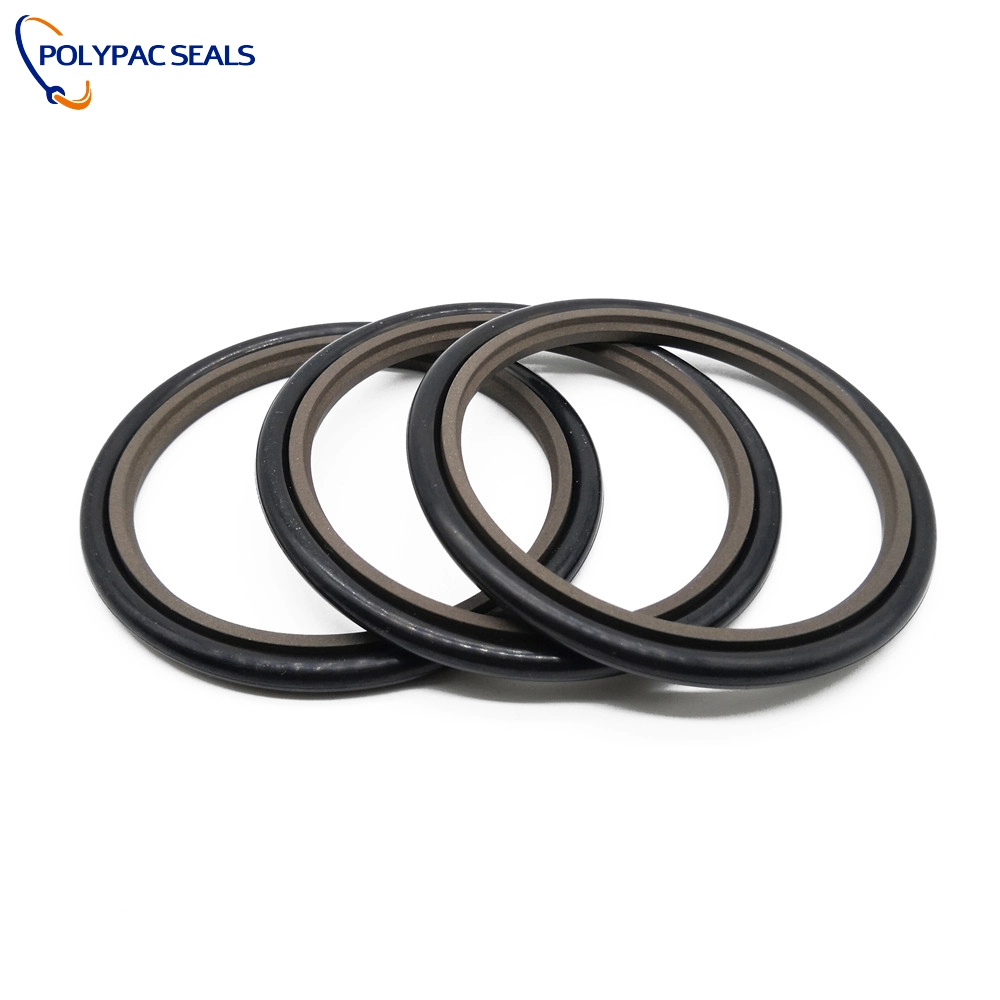
| PTFE (virgin and filled) | -200 to +260 | Very high when supported (with backup rings) | Very high | Very low | Excellent almost universal | High-pressure, low-friction applications; often used as a sliding element |
| Silicone | -60 to +200 | Low to moderate | Poor | Low | Poor with hydrocarbons | Low-load, high/low temp but not recommended for hydraulic piston seals under high pressure |
Notes: Typical Max Pressure is indicative and depends heavily on seal profile, extrusion gap and use of back-up rings. PTFE materials require appropriate gland design or backup rings at high pressures; PU and HNBR are commonly used where extrusion resistance and wear life are primary concerns. Data sources: industry seal manufacturer datasheets and engineering handbooks (see references).
Filled PTFE vs. Virgin PTFE — when fillers matter
Pure PTFE has excellent chemical resistance and low friction but can cold-flow (creep) and is softer under load. Fillers such as bronze, carbon, graphite or MoS2 are added to improve wear resistance, reduce creep and increase pressure capability. Filled PTFE is commonly used in high-pressure piston seals when low friction and long life are required—provided extrusion is controlled by geometry or backup rings.
How pressure and extrusion risk drive material & design choice
High pressure increases the risk of extrusion of the seal into the gap between piston and cylinder bore. To manage this risk, designers must consider a combination of:
- Material hardness and modulus (harder compounds resist extrusion but increase friction).
- Seal cross-section/profile (U-cups, piston rings, lip seals have different extrusion characteristics).
- Back-up rings (often PTFE or composite rings placed on the low-pressure side to block extrusion paths).
- Clearance/tolerance control in the gland and bore (smaller extrusion gaps reduce extrusion risk).
Rule-of-thumb: for continuous pressures above ~200–250 bar, plan for either high-modulus materials (PU, HNBR) with optimized geometry or PTFE-based seals with back-up rings. For intermittent spikes higher than static ratings, always verify with burst/extrusion testing and consider pressure-relief strategies in system design.
Temperature and fluid compatibility — matching seals to the environment
Temperature affects elastomer elasticity and life. NBR is cost-effective for ambient temperatures up to ~100°C but ages quickly at elevated temperatures. HNBR extends high-temperature endurance; FKM and FFKM tolerate still higher temperatures and aggressive fluids (but at higher cost). PTFE tolerates broad temperatures and is chemically versatile, making it a strong candidate where both high pressure and aggressive media are present.
Sliding speed and friction — balancing efficiency and wear
Frictional heating and wear increase with sliding speed and duty cycle. Low-friction materials (PTFE and filled PTFE) reduce power loss and heat generation, but need support to prevent extrusion. Polyurethane has higher friction than PTFE but excellent wear life—often preferred for mobile hydraulics with abrasive contaminants.
Design and testing recommendations before production
A robust validation plan should include:
- Finite element analysis (FEA) of seal deformation at operating pressure and temperature to assess extrusion and contact stresses.
- Material compatibility testing with the actual fluid and contaminants (swelling, hardness change, tensile strength reduction).
- Laboratory cyclic testing at representative temperature, pressure and speed to determine wear rates and leakage trends.
- Field pilot runs to observe long-term behavior under real contamination, shock loads and thermal cycling.
Cost vs. performance: how to make a pragmatic choice
High-performance materials like FFKM or filled PTFE are more expensive but can dramatically lower lifecycle costs by extending maintenance intervals or preventing catastrophic leakage. Often the optimal approach is a graded strategy: use polyurethane or HNBR for general-purpose cylinders and upgrade to filled PTFE or FFKM for critical, high-pressure or chemically aggressive service. Consider total cost of ownership (TCO), not only initial material cost.
Comparison table: Material selection checklist for common scenarios
| Application Scenario | Recommended Material(s) | Key Reason |
|---|---|---|
| Mobile hydraulics with abrasive contamination | Polyurethane (PU) | Superior wear resistance and toughness |
| High-pressure industrial cylinder (>300 bar) | Filled PTFE with back-up rings or PU with engineered gland | Low friction and high pressure capability when adequately supported |
| High-temp (150–200°C) with oils | FKM or HNBR (depending on chemical mix) | Heat and oxidation resistance |
| Aggressive chemicals or steam | FFKM or PTFE | Broad chemical resistance |
| Low-pressure, wide temperature swings | Silicone (non-hydrocarbon) or special elastomers | Excellent low/high temperature flexibility; limited for high pressure |
Manufacturing and quality considerations
Consistency in compound mixing, molding or machining tolerances, and post-processing (baking, finishing) can significantly affect seal performance. Tight control of hardness (±3 Shore points), dimensional tolerances and surface finish will reduce variability in life and leakage rates. Specify material certifications and batch traceability when ordering critical seals.
Polypac — custom materials, production capacity and technical capability
Polypac is a scientific and technical hydraulic seal manufacturer and oil seal supplier specializing in seal production, sealing material development, and customized sealing solutions for special working conditions. Polypac's custom rubber ring and O-ring factory covers an area of more than 10,000 square meters, with a factory space of 8,000 square meters. Our production and testing equipment are among the most advanced in the industry. As one of the largest companies in China dedicated to the production and development of seals, we maintain long-term communication and cooperation with numerous universities and research institutions both domestically and internationally.
Founded in 2008, Polypac began by manufacturing filled PTFE seals, including bronze-filled PTFE, carbon-filled PTFE, graphite PTFE, MoS₂-filled PTFE, and glass-filled PTFE. Today, we have expanded our product line to include O-rings made from various materials such as NBR, FKM, silicone, EPDM, and FFKM.
Polypac core products and advantages:
- Main products: O-Rings, Rod Seals, Piston Seals, End Face Spring Seals, Scraper Seals, Rotary Seals, Back-up Rings, Dust Rings.
- Competitive points: in-house material development (filled PTFE formulations), large-scale manufacturing capacity, advanced testing (pressure, cyclic life, chemical ageing), and close R&D partnerships with universities.
- Technical strengths: capability to produce precision-filled PTFE components and custom elastomer compounds tailored to specific hydraulic fluids and high-pressure applications.
How Polypac can help your piston seal material decision
Polypac offers material screening, sample production, and accelerated life testing to validate the selected piston seal material under customer-specific conditions (pressure profile, fluid, temperature and speed). For engineers evaluating options, Polypac can provide test reports, dimensional samples, and guidance on gland design to minimize extrusion and extend service life.
Practical checklist before finalizing piston seal material
- Define maximum continuous and peak pressure together with expected pressure spikes and frequency.
- Specify full temperature range, noting transient peaks and low-temperature starts.
- Provide exact fluid composition (brand/type), contamination levels and particulate risk.
- Set acceptable friction level and power-loss limits if efficiency is critical.
- Decide acceptable maintenance interval / target service life.
- Request sample testing from your seal supplier (cyclic, chemical exposure, extrusion test).
FAQ — Selecting piston seal material for high-pressure applications
1. What is the best material for piston seals at pressures above 300 bar?
There is no single best material. Two common approaches are: (a) filled PTFE seals supported by back-up rings — deliver low friction and excellent wear life when gland design prevents extrusion; (b) high-modulus elastomers such as polyurethane or HNBR with optimized profiles — deliver excellent extrusion resistance and durability. Selection depends on temperature, fluid and allowable friction.
2. Do I always need backing rings at high pressure?
Backup rings (PTFE or composite) are strongly recommended when using low-modulus materials (e.g., PTFE, some elastomers) in glands where extrusion gaps exist and pressure exceeds approximately 200–250 bar. They prevent extrusion and dramatically increase operating pressure capability.
3. Can I use PTFE for dynamic piston seals?
Yes—especially filled PTFE variants (bronze, carbon, graphite, MoS₂) are widely used for dynamic piston seals because of low friction and high wear resistance. However, they require careful gland design and often backup rings to avoid extrusion under high pressure.
4. How do I test material compatibility with a new hydraulic fluid?
Supplier labs can perform immersion tests measuring swelling, hardness change and tensile retention at representative temperatures for defined durations (e.g., 168 hours, 500 hours). Functional cyclic testing with the actual fluid is recommended to detect changes in friction or wear behavior.
5. Which is more important: low friction or wear resistance?
Both matter but priorities depend on application. For energy-sensitive systems (servo/hydrostatic drives), low friction may be prioritized (PTFE). For heavy-duty or contaminated environments, wear resistance (PU/HNBR) and extrusion resistance often take precedence.
6. How quickly should I involve a seal manufacturer in the design process?
Early. Engaging a seal manufacturer during the early design phase enables optimization of gland geometry, tolerance specifications and material selection—reducing costly redesigns and ensuring manufacturability.
Contact and next steps
If you need help selecting the optimal piston seal material for a high-pressure application, request samples and test reports from an experienced supplier. Polypac can provide application-specific material recommendations, prototype seals (filled PTFE and elastomers), and accelerated testing. Contact Polypac's technical team for consultation or to view product datasheets for O-Rings, Rod Seals, Piston Seals, End Face Spring Seals, Scraper Seals, Rotary Seals, Back-up Rings and Dust Rings.
CTA: For a material review, sample order or technical consultation, contact Polypac at info@polypac.com or visit https://www.polypac.com. Ask for application engineering support and accelerated life test options.
References
- SKF — Seals: product and technical information. https://www.skf.com/group/products/seals (Accessed 2025-12-13)
- Trelleborg Sealing Solutions — Seals and materials guidance. https://www.trelleborg.com/en/seals (Accessed 2025-12-13)
- Wikipedia — Polytetrafluoroethylene. https://en.wikipedia.org/wiki/Polytetrafluoroethylene (Accessed 2025-12-13)
- Wikipedia — Polyurethane. https://en.wikipedia.org/wiki/Polyurethane (Accessed 2025-12-13)
- Wikipedia — Nitrile rubber. https://en.wikipedia.org/wiki/Nitrile_rubber (Accessed 2025-12-13)
- MatWeb — Materials database (searchable property data for elastomers and thermoplastics). https://www.matweb.com/ (Accessed 2025-12-13)
- Polypac corporate information and product capabilities (company materials and technical background as cited). (Polypac internal materials, company website) https://www.polypac.com (Accessed 2025-12-13)

High-Performance Pneumatic Piston Seals: How to Achieve Zero-Leakage Efficiency

PTFE vs. Composite: Choosing the Best Piston Guide Ring Material for High-Pressure Systems

Mastering O-Ring Gland Design: The Complete Guide for Perfect Sealing Performance

Advanced Back-Up Ring Materials: Beyond PTFE for Extreme Temperature Environments

PTFE vs. Urethane Scrapers: Which Material Truly Prevents Contamination?
Products
What is the difference between a static seal and a dynamic seal?
How do I choose the right material for my sealing application?
What is the difference between NBR and FKM materials?
Why did my O-ring fail prematurely?
Can I reuse a seal?
Stay Updated with Industry Insights
Subscribe to our articles and receive the latest news, expert guidance, and technical updates directly in your E-mail.
Rest assured that your privacy is important to us, and all information provided will be handled with the utmost confidentiality.

Polypac is a trusted global supplier of high-performance sealing solutions, providing OEM & ODM services for industries worldwide.
E-mail:
Phone/WhatsApp:
© 2025 Polypac Seals. All Rights Reserved.
dms
DMS
DMS