












PTFE Oil Seal Customization: Lip Profiles and Reinforcement
Optimizing Seal Performance: Lip Profiles and Reinforcement in PTFE Oil Seals
Why PTFE oil seals are chosen for demanding applications
ptfe oil seal choices are increasingly common in hydraulic, pneumatic, and rotary applications where low friction, chemical resistance and wide temperature range are required. PTFE (polytetrafluoroethylene) combines very low coefficient of friction, broad chemical compatibility (pH 0–14 for many fluids) and service temperatures from roughly -200°C up to 260°C for virgin PTFE. These intrinsic material advantages make PTFE an excellent base material for oil seals, but achieving reliable sealing requires careful attention to lip profile, reinforcement and energizing strategy to overcome PTFE's lower elastic recovery and higher cold flow compared with elastomers. (Sources: Chemours Teflon product info; Wikipedia PTFE)
Lip profile fundamentals and their impact on sealing behavior
The lip profile is the primary interface between seal and mating surface; it governs contact pressure distribution, leakage paths, friction, and wear. For ptfe oil seal customization, lip geometry must be chosen to match motion type (static, reciprocating, rotary), pressure, shaft hardness, surface finish and speed. Common lip profile considerations include single vs double lips, chamfered vs knife-edge lips, and compound shapes that combine wiping and pressure-balanced features.
Common PTFE lip profiles and application guidance
Below is a practical comparison of commonly used lip profiles for PTFE oil seals to help selection.
| Lip Profile | Typical Use | Advantages | Limitations |
|---|---|---|---|
| Single knife-edge lip | Low-pressure rotary, low friction applications | Minimal friction; good for high-speed, low-leak | Less tolerant to shaft misalignment and poor surface finish |
| Double lip / primary + dust lip | Rotary shafts with contamination or moderate pressure | Improved contamination exclusion; longer service life | Higher friction; requires more precise molding |
| U-cup / pressure-assisted lip | Reciprocating pistons and rods, higher pressure | Self-energizing under pressure; better sealing at higher P | More complex; requires proper energizer or back-up |
| Spring-energized lip | Vacuum, static sealing, or wide temperature range | Consistent initial contact, compensates for wear and creep | Costlier; spring selection critical for load vs friction balance |
| Composite lip (PTFE on elastomer) | Rotary seals needing low friction plus elasticity | Combines low friction with good sealing preload and adaptability | Overmolding complexity; temperature and chemical limits set by elastomer |
Reinforcement strategies for PTFE oil seals
Because virgin PTFE is relatively soft and exhibits cold flow (creep) under sustained stress, reinforcement is used to enhance load capacity, reduce extrusion risk and stabilize geometry. Key reinforcement approaches include:
- Bronze- or glass-filled PTFE — improves wear resistance and reduces creep; useful on rotating shafts where improved tribological behavior is needed.
- Carbon- or graphite-filled PTFE — balances improved wear performance and lower friction; often used where dry-running capability matters.
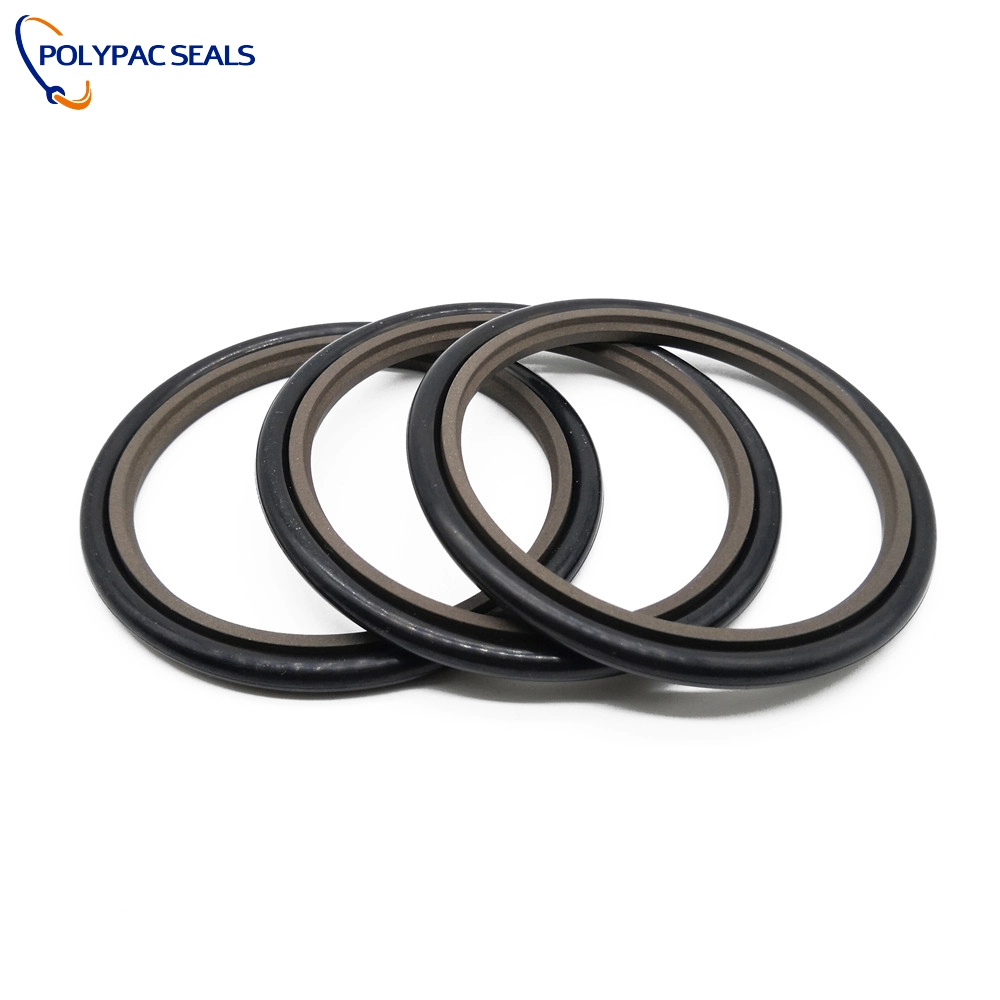
- Metal inserts / back-up rings — add radial stiffness and extrusion resistance in high-pressure applications.
- Spring energizers — stainless-steel springs embedded or captured at the lip provide reliable contact force over temperature, compensating for PTFE's limited elasticity.
- Elastomer energizers / overmolding — PTFE sealing face on an elastomeric body (e.g., FKM, NBR) provides preload and easier assembly while maintaining a PTFE running surface.
How reinforcement affects material selection and manufacturing
Choosing filled PTFE vs composite structures changes molding and machining steps. Filled PTFE grades machine differently (typically better wear resistance) but may have slightly higher friction. Overmolded PTFE on elastomer requires specialized co-molding or bonding processes and detailed thermal management to avoid delamination. Spring-energized PTFE seals must be designed so the spring is captured without creating stress concentrations that accelerate creep or cracking.
Key design parameters: shaft finish, hardness, tolerance, and pressure limits
Successful ptfe oil seal custom designs require matching lip geometry and reinforcement to hardware. Typical engineering guidelines (industry practice summarized from seal manufacturers):
- Recommended shaft hardness: HRC 40–60; for soft shafts use a hardened sleeve to reduce wear.
- Shaft surface finish (Ra): 0.2–0.8 µm (8–32 µin) for dynamic PTFE seals; very smooth surfaces reduce wear but may affect fluid retention.
- Shaft roundness and runout: minimize eccentricity to prevent intermittent lip lift and accelerated wear.
- Pressure capability: unbacked PTFE lips are typically limited to moderate pressures; back-up rings and metal inserts expand pressure capability substantially (>10–20 MPa depending on configuration).
Reference note: these ranges are consistent with industry guidance from major seal manufacturers and technical handbooks; exact limits depend on lip profile, energizer and operating environment (temperature, medium).
Testing, standards and validation for custom PTFE oil seals
Design validation should include bench testing that mirrors field conditions: accelerated wear tests, leakage under static/dynamic conditions, thermal cycling, chemical compatibility checks, and extrusion testing at maximum expected pressure. Where applicable, reference standards such as ISO hydraulic seal test protocols and company-specific OEM durability tests should be used. Documented test reports with measured leakage (cc/min), friction torque, and dimensional changes over time provide verifiable evidence of performance.
Cost, lead time and manufacturability considerations
Customization increases design robustness but affects cost and lead time. Factors that influence unit cost include: complex lip tooling (tight tolerances increase CNC/mold time), use of filled PTFE compounds, multi-component overmolding, and spring capture features. Typical lead time for a qualified custom PTFE oil seal (prototype tooling, sample testing) ranges from 4–12 weeks depending on complexity and backlog; serial production lead times then depend on batch size and finishing operations. Early-stage DFMEA (design failure mode and effects analysis) reduces iteration and total time-to-market.
Application examples and selection checklist
Use these questions to narrow down lip and reinforcement choices for a ptfe oil seal requirement:
- Motion type: rotary/reciprocating/static?
- Operating pressure and maximum pressure spikes?
- Temperature range and fluid/chemical exposure?
- Shaft hardness, size, surface finish and runout?
- Acceptable friction and breakaway torque?
- Contamination risk and space envelope for secondary lips or dust seals?
Example: For a high-speed rotary shaft (3,000 rpm) with moderate pressure and contamination, a composite PTFE running face over elastomer backup with a secondary dust lip and optimized knife-edge primary lip often gives the best balance of low friction, adaptability and contamination resistance.
Polypac capabilities in custom PTFE oil seals and reinforcement solutions
Polypac is a scientific and technical hydraulic seal manufacturer and oil seal supplier specializing in seal production, sealing material development, and customized sealing solutions for special working conditions. Polypac's custom rubber ring and O-ring factory covers an area of more than 10,000 square meters, with a factory space of 8,000 square meters. Our production and testing equipment are among the most advanced in the industry. As one of the largest companies in China dedicated to the production and development of seals, we maintain long-term communication and cooperation with numerous universities and research institutions both domestically and internationally.
Founded in 2008, Polypac began by manufacturing filled PTFE seals, including bronze-filled PTFE, carbon-filled PTFE, graphite PTFE, MoS₂-filled PTFE, and glass-filled PTFE. Today, we have expanded our product line to include O-rings made from various materials such as NBR, FKM, silicone, EPDM, and FFKM.
Polypac core products and competencies: O-Rings, Rod Seals, Piston Seals, End Face Spring Seals, Scraper Seals, Rotary Seals, Back-up Rings, Dust Ring. Competitive strengths include:
- Deep PTFE expertise — experience with multiple filled PTFE grades for tailored wear and friction properties.
- Advanced manufacturing — precision machining, overmolding and spring capture technologies to produce multi-component PTFE seals.
- Testing and R&D collaboration — partnerships with universities and institutions to validate materials and seals for special conditions (high temperature, aggressive fluids, vacuum).
- Large-scale facilities — an extensive factory footprint enabling both prototyping and high-volume production with consistent quality controls.
These capabilities make Polypac well-suited to deliver custom ptfe oil seal solutions where lip profile tailoring and appropriate reinforcement are critical to performance.
Practical recommendations for engineers specifying custom PTFE oil seals
When preparing a request for quotation (RFQ) or technical specification include:
- Detailed operating conditions (temperature, pressure, speed, media)
- Shaft/cylinder material, hardness, surface finish (Ra) and tolerances
- Expected lifetime or maintenance interval and acceptable leakage rate
- Assembly constraints (radial/axial space) and installation method
- Any budget or lead-time constraints
Provide measured or CAD geometry where possible. Early communication with the seal supplier on expected failure modes (abrasion, extrusion, thermal degradation) will reduce redesign cycles.
FAQs — Frequently Asked Questions
Q1: What lip profile is best for high-speed rotary shafts?
A1: Knife-edge or thin-profile single lips on filled PTFE grades are commonly chosen for high-speed rotary shafts because they minimize friction. A composite PTFE-on-elastomer design can add preload and reduce vibration sensitivity if space allows.
Q2: When should I use spring-energized PTFE seals?
A2: Use spring-energized designs where consistent contact force over temperature, compensation for wear, or vacuum/low-pressure sealing is required. They are especially useful for static and low-speed rotary seals operating across wide temperature ranges.
Q3: Can filled PTFE eliminate the need for back-up rings at high pressure?
A3: Filled PTFE improves extrusion resistance, but at high pressures back-up rings or metal inserts are still often required to prevent extrusion and maintain geometry. The need depends on pressure, gap dimensions and lip geometry.
Q4: What shaft finish do PTFE seals require?
A4: Typical recommendations for dynamic PTFE seals are shaft Ra 0.2–0.8 µm. Extremely smooth surfaces reduce fluid retention and may change sealing behavior; extremely rough surfaces increase wear. Match finish to the specific lip profile and application.
Q5: How do chemical compatibility and temperature affect lip and reinforcement choices?
A5: PTFE offers broad chemical resistance and high temperature capability. If elastomer energizers or overmolds are used, their chemical resistance and temperature limits (e.g., FKM vs NBR) must be evaluated. Filled PTFE grades may change chemical and thermal behavior slightly and should be validated for the intended environment.
Q6: What testing should be requested from a supplier for a custom PTFE oil seal?
A6: Ask for leakage vs pressure curves, friction torque at relevant speeds, accelerated wear testing (hours/km or cycles), thermal cycling data, and dimensional stability (creep) measurements. Where possible, request samples for in-house verification under real-system conditions.
Contact Polypac for customized PTFE oil seal solutions
If you need a tailored ptfe oil seal solution — from lip-profile optimization to reinforcement strategy and prototype validation — contact Polypac's technical team to discuss design requirements, receive engineering recommendations, and request samples. View product catalogs or request a quotation to evaluate how our filled PTFE experience and multi-material manufacturing can meet your sealing challenges.
References and further reading
- Polytetrafluoroethylene (PTFE) — Wikipedia. https://en.wikipedia.org/wiki/Polytetrafluoroethylene (accessed 2025-12-26)
- Chemours — Teflon PTFE product and technical information. https://www.chemours.com/en/brands/teflon (accessed 2025-12-26)
- SKF — Seals: product and technical resources. https://www.skf.com/group/products/seals (accessed 2025-12-26)
- Industry seal selection guidance — manufacturer technical notes (examples: major seal manufacturers' technical libraries and handbooks). For general shaft surface and seal guidance see SKF technical resources referenced above (accessed 2025-12-26)
- MatWeb — material property database for PTFE and filled PTFE compounds. https://www.matweb.com/ (accessed 2025-12-26)
For specific test standards and protocols consult ISO and ASTM documents applicable to hydraulic seals and polymer testing. Suppliers like Polypac can provide test reports and material data sheets on request.

High-Performance Pneumatic Piston Seals: How to Achieve Zero-Leakage Efficiency

PTFE vs. Composite: Choosing the Best Piston Guide Ring Material for High-Pressure Systems

Mastering O-Ring Gland Design: The Complete Guide for Perfect Sealing Performance

Advanced Back-Up Ring Materials: Beyond PTFE for Extreme Temperature Environments

PTFE vs. Urethane Scrapers: Which Material Truly Prevents Contamination?
Products
When should I use a spring-energized seal instead of a standard elastomeric seal?
How can I prevent seal damage during installation?
What is the purpose of the metal spring in a rotary shaft seal?
What is the difference between NBR and FKM materials?
Can I reuse a seal?
Stay Updated with Industry Insights
Subscribe to our articles and receive the latest news, expert guidance, and technical updates directly in your E-mail.
Rest assured that your privacy is important to us, and all information provided will be handled with the utmost confidentiality.

Polypac is a trusted global supplier of high-performance sealing solutions, providing OEM & ODM services for industries worldwide.
E-mail:
Phone/WhatsApp:
© 2025 Polypac Seals. All Rights Reserved.
dms
DMS
DMS