












How PTFE Spring-Energized Seals Improve Wear Resistance

How PTFE Spring-Energized Seals Improve Wear Resistance
What is a PTFE Seal and how does spring-energizing work?
A PTFE Seal is a sealing element made from polytetrafluoroethylene (PTFE), a low-friction, chemically resistant polymer. In spring-energized PTFE seals, a thin metallic spring (or other energizing element) is embedded behind or inside the PTFE lip to provide a controlled radial load against the mating surface. This combination allows the PTFE polymer to compensate for shaft/bore misalignments, thermal expansion and wear while maintaining consistent contact pressure—resulting in reliable sealing over long service intervals.
Why wear resistance matters for hydraulic cylinders and PTFE Seal selection
Wear on sealing surfaces directly increases leakage, reduces system efficiency, and leads to unplanned downtime. For hydraulic cylinders used in mining, construction, marine and industrial automation, minimizing seal wear reduces maintenance frequency and total cost of ownership. Choosing a PTFE Seal—especially a spring-energized design—targets wear resistance at three levels: material properties (low coefficient of friction and chemical stability), mechanical design (consistent contact pressure via a spring), and geometry (optimized lip and backup shapes for pressure distribution).
Material advantages of PTFE for enhanced wear resistance
PTFE’s intrinsic material properties make it particularly suited for applications where wear resistance is critical:
- Low friction: PTFE has one of the lowest coefficients of friction of common engineering polymers, minimizing abrasive interaction between seal and shaft.
- Chemical inertness: PTFE resists hydraulic fluids, solvents and many aggressive chemicals, reducing material degradation that accelerates wear.
- Wide temperature range: PTFE maintains properties from approximately -200°C to +260°C, preserving sealing geometry and reducing thermal wear in fluctuating environments (source: DuPont PTFE datasheets).
- Dimensional stability: PTFE can be compounded and filled to reduce creep and cold flow, improving long-term sealing contact and wear performance.
How spring-energized designs reduce abrasive and adhesive wear
A spring-energized PTFE Seal reduces wear through controlled contact mechanics. The spring applies a predictable, constant radial force that keeps the PTFE lip lightly pressed to the moving surface. Benefits include:
- Stable sealing force despite pressure fluctuations—prevents intermittent contact that can cause fretting wear.
- Reduced stick-slip and micro-welding—PTFE’s low friction plus consistent spring load prevents adhesive wear common with metal-elastomer contacts.
- Automatic compensation for wear—soft PTFE may experience minor material loss over time, but the spring maintains contact pressure to extend service life.
Design features that increase wear resistance in bidirectional PTFE Seals
Design choices determine how well a PTFE Seal performs. For bidirectional piston seals like the GNS Piston Seal, critical features include:
- Bidirectional lips: Symmetric sealing lips provide equal performance in extension and retraction strokes, distributing wear evenly across the seal profile.
- Compact cross-section: A compact design reduces installation space and improves stability against extrusion, lowering scuffing under lateral loads.
- Backup and anti-extrusion geometry: Rigid backup rings or profile shoulders protect the PTFE lip under high pressure, preventing extrusion-related damage.
- Spring placement: Internal or external springs must be positioned to deliver uniform radial force without creating stress concentrations that accelerate local wear.
GNS Piston Seal | Bidirectional PTFE Seal for Hydraulic Cylinders — product overview
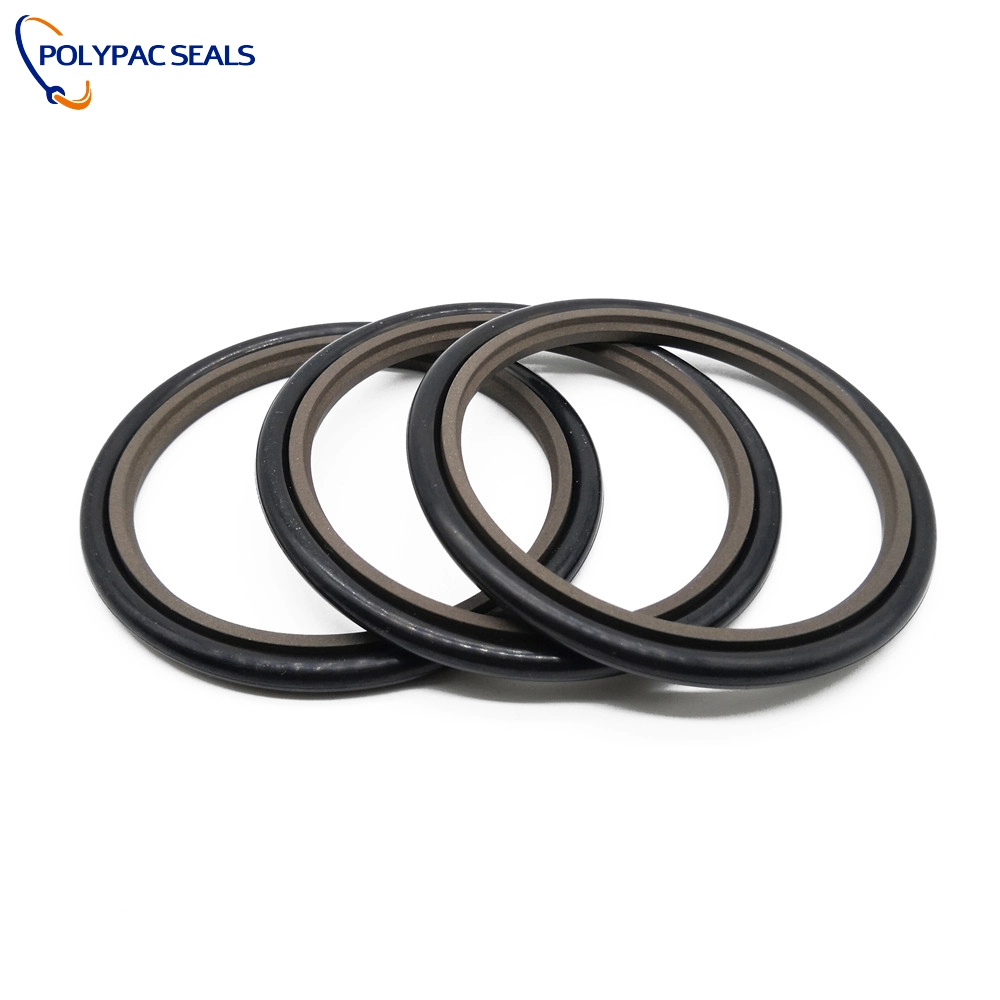
Polypac’s GNS Piston Seal is a compact, bidirectional PTFE seal designed for hydraulic cylinders. Engineered for high pressure, it ensures reliable sealing performance and durability in demanding industrial applications. Ideal for efficient, long-lasting piston operation, the GNS Piston Seal combines a tailored PTFE compound with a resilient energizing element to maintain contact under pressure and compensate for wear and thermal changes.
Performance comparison: PTFE spring-energized vs elastomer seals
Below is a practical comparison between typical PTFE spring-energized seals and conventional elastomer piston seals across attributes that affect wear resistance.
| Attribute | PTFE Spring-Energized Seal | Elastomer Seal (NBR/PU) |
|---|---|---|
| Wear resistance | Excellent—low friction and durable lip geometry | Good to fair—higher friction, faster degradation under abrasive media |
| Chemical resistance | Excellent—resists most hydraulic fluids and chemicals | Variable—dependent on elastomer compound; can swell or harden |
| Temperature range | -200°C to +260°C (material dependent) | Typically -40°C to +100°C (compound dependent) |
| Friction | Low—reduces abrasive wear and energy loss | Higher—can increase wear and power consumption |
| Pressure capability | High—engineered designs commonly used in high-pressure cylinders | Moderate—effective but prone to extrusion at very high pressures unless backed up |
Source: Manufacturer technical notes and engineering references (see sources list below).
Maintenance, lifecycle and cost-effectiveness of PTFE Seals
Although PTFE spring-energized seals can have higher initial cost than standard elastomer seals, their longer service life, reduced downtime and improved energy efficiency often produce lower lifecycle cost. Key maintenance benefits include:
- Extended mean time between maintenance (MTBM) due to higher abrasion and chemical resistance.
- Predictable wear behavior—spring compensation often allows seals to remain serviceable until planned maintenance.
- Less frequent replacement of mating surfaces—low-friction PTFE reduces scoring and damage on rods and bores.
Selecting the right PTFE Seal for hydraulic cylinders
When selecting a PTFE Seal such as the GNS Piston Seal, consider the following application parameters to maximize wear resistance:
- Operating pressure and pressure spikes—select a design with appropriate backup and extrusion resistance for your peak pressures.
- Surface finish and hardness of rod/bore—PTFE performs best with polished, hard surfaces; rough or soft surfaces increase wear.
- Fluid compatibility—verify PTFE compound grade for specific hydraulic fluids, additives and contaminants.
- Temperature range—match material variants to expected ambient and fluid temperatures to prevent creep or hardening.
- Installation groove and tolerances—proper gland design preserves spring preload and avoids distortion that can accelerate wear.
Implementation best practices to reduce wear during installation and operation
Correct installation and commissioning reduce early-life wear and maximize the service life of PTFE Seals:
- Inspect and prepare mating surfaces—clean, deburr and ensure correct surface finish (typically Ra <0.4 µm for rods; consult manufacturer).
- Use compatible lubrication during installation—minimize dry sliding during initial cycles.
- Follow recommended gland tolerances—over-compression or insufficient clearance will increase local stresses and wear.
- Perform controlled break-in cycles—start with low speed and pressure increases to seat the seal uniformly without scoring.
Real-world applications where PTFE spring-energized seals excel
PTFE spring-energized seals are widely used where durability and wear resistance are priorities. Typical applications include:
- Mobile and industrial hydraulic cylinders subject to contamination and variable loads (construction, mining equipment).
- Marine hydraulics and subsea actuators that require chemical resistance and long maintenance intervals.
- High-temperature or chemically aggressive environments in process industries.
In these scenarios, a well-designed PTFE Seal reduces downtime, extends overhaul intervals and protects expensive cylinder components from wear.
Brand advantages: Why choose Polypac’s GNS Piston Seal for improved wear resistance
Polypac’s GNS Piston Seal merges industry-proven PTFE technology with application-focused engineering. Key brand and product advantages include:
- Purpose-built for hydraulic cylinders: Compact, bidirectional geometry makes GNS an efficient replacement in confined gland spaces without sacrificing performance.
- High-pressure capability: Engineered to maintain sealing integrity under demanding loads while the spring-energized design compensates for wear and thermal effects.
- Durability and reduced lifecycle cost: The PTFE compound and energizing mechanism prioritize low friction and high wear resistance to lower maintenance frequency.
- Application support: Polypac provides material selection guidance, gland specifications and installation best practices to ensure optimal wear performance in your system.
Installation and service support to protect your investment
Choosing a reputable supplier reduces the risk of premature wear. Polypac offers technical documentation (gland drawings, tolerance recommendations), material traceability and supplier support to help engineers correctly integrate GNS Piston Seal into new or existing cylinders—minimizing installation errors that commonly lead to early wear.
Frequently Asked Questions (FAQ)
Q1: How does the GNS Piston Seal differ from standard rubber piston seals?
A1: The GNS Piston Seal uses a PTFE sealing element combined with an energizing spring, giving it a lower coefficient of friction, superior chemical resistance and better temperature tolerance than typical rubber seals. This results in improved wear resistance and longer service life in harsh conditions.
Q2: Can PTFE spring-energized seals handle high hydraulic pressures?
A2: Yes. When correctly designed with appropriate backup features and gland geometry, spring-energized PTFE seals are suitable for high-pressure hydraulic cylinders. Specify the expected maximum pressure and any pressure spikes when consulting Polypac so the GNS Piston Seal can be configured appropriately.
Q3: What surface finish and hardness are recommended to minimize wear?
A3: Polished, hard rod surfaces reduce abrasive wear on PTFE lips. A typical target surface finish is Ra <0.4 µm for rods and sufficient bore hardness (e.g., induction-hardened or chrome-plated rods) to avoid embedding and scoring. Exact recommendations depend on seal design—consult Polypac datasheets.
Q4: Are PTFE seals suitable for bidirectional piston applications?
A4: Absolutely. The GNS Piston Seal is specifically designed as a bidirectional PTFE Seal, providing balanced sealing performance on both extension and retraction strokes and distributing wear more evenly across the seal lips.
Q5: How should I store PTFE seals before installation?
A5: Store in a clean, dry environment away from direct sunlight and extreme temperatures. Keep seals in their original packaging until installation to prevent contamination and deformation.
Contact us / View product
To discuss application requirements or request technical drawings and samples for the GNS Piston Seal | Bidirectional PTFE Seal for Hydraulic Cylinders, contact Polypac sales: email sales@polypac.example or visit our product page (replace with your product URL) to view specifications and request a quote.
Sources and further reading
- DuPont PTFE Technical Data — typical service temperature ranges and chemical resistance of PTFE (DuPont Tyflon™ / PTFE datasheets).
- Manufacturer technical notes on spring-energized seals and high-pressure hydraulic seals (Parker, Trelleborg, SKF white papers).
- Industry sealing handbooks and engineering guides on surface finish and gland design for piston seals.
Note: For specific numeric proof points (pressure ratings, material variants and surface finish tolerances) and to obtain CAD/gland dimensions, contact Polypac with your operating parameters so we can specify the correct GNS Piston Seal configuration for optimal wear resistance.

High-Performance Pneumatic Piston Seals: How to Achieve Zero-Leakage Efficiency

PTFE vs. Composite: Choosing the Best Piston Guide Ring Material for High-Pressure Systems

Mastering O-Ring Gland Design: The Complete Guide for Perfect Sealing Performance

Advanced Back-Up Ring Materials: Beyond PTFE for Extreme Temperature Environments

PTFE vs. Urethane Scrapers: Which Material Truly Prevents Contamination?
Products
Why did my O-ring fail prematurely?
What does "AS568" mean?
How do I choose the right material for my sealing application?
What is the difference between a static seal and a dynamic seal?
When should I use a spring-energized seal instead of a standard elastomeric seal?
Stay Updated with Industry Insights
Subscribe to our articles and receive the latest news, expert guidance, and technical updates directly in your E-mail.
Rest assured that your privacy is important to us, and all information provided will be handled with the utmost confidentiality.

Polypac is a trusted global supplier of high-performance sealing solutions, providing OEM & ODM services for industries worldwide.
E-mail:
Phone/WhatsApp:
© 2025 Polypac Seals. All Rights Reserved.
dms
DMS
DMS