












PTFE vs Rubber for Piston Seals: Pros and Cons
Selecting Piston Seal Material: When to Choose PTFE or Rubber
Choosing the right piston seal material is a critical decision for hydraulic and pneumatic system reliability, efficiency and lifetime cost. This article compares PTFE and common rubber elastomers (NBR, FKM, EPDM, silicone) for piston seal material selection, outlining measurable pros and cons, application guidelines, testing considerations and practical tips from industry practice.
Why piston seal material matters
Piston seal material affects leak rate, friction (hysteresis), service life, contamination sensitivity, start-up torque, and maintenance intervals. Selecting an inappropriate material often appears economical initially but leads to premature wear, extrusion damage, high energy loss or unexpected downtime. This section frames the decision variables: operating temperature, fluid/chemical compatibility, pressure and extrusion gap, dynamic vs static duty, acceptable friction, and cost.
Material fundamentals: PTFE vs rubber (overview of piston seal material properties)
PTFE (polytetrafluoroethylene) is a semi-crystalline fluoropolymer with outstanding chemical resistance, very low friction and excellent high-/low-temperature capability. It is dimensionally stable and has poor elasticity compared with elastomers, so PTFE seals often require energizing elements (springs, O-rings, metal springs) or special geometries to maintain sealing contact.
Rubber elastomers (commonly NBR/ nitrile, FKM/Viton®, EPDM, silicone) are soft, highly elastic materials that create sealing contact by deformation. They provide excellent immediate sealing at low pressures, good resilience, and shock absorption, but vary widely in chemical and temperature resistance, compression set, wear resistance and friction.
Head-to-head comparison: measurable properties of piston seal material
The table below summarizes typical, commonly cited differences. Values are directional and depend on compound, filler and seal design; always consult specific material datasheets and perform bench/pilot testing under representative conditions.
| Property | PTFE (incl. filled PTFE) | Rubber Elastomers (NBR / FKM / EPDM / Silicone) |
|---|---|---|
| Typical temperature range | -200°C to +260°C (depends on grade; filled PTFE similar) | NBR: -40°C to +120°C; FKM: -20°C to +200°C; EPDM: -50°C to +150°C; Silicone: -60°C to +200°C |
| Chemical resistance | Excellent to nearly all media (strong oxidizers and molten alkali are exceptions) | Variable: NBR good for mineral oils; FKM excellent for petroleum and many chemicals; EPDM resists water/steam/glycols but not petroleum |
| Static/dynamic friction | Very low (coef. ~0.05–0.10), good for high-speed reciprocation | Higher (coef. ~0.5–1.5); design-dependent — lip geometry and lubrication reduce friction |
| Elasticity / energy absorption | Low elasticity; depends on spring/energizer | High elasticity; inherent sealing without energizer |
| Extrusion resistance | High when filled/rigid PTFE; pure PTFE susceptible unless backup used | Good when designed with correct hardness and backup rings; softer rubbers may extrude at high pressure |
| Wear resistance | Excellent, especially with graphite/bronze/moS2 fillers | Moderate; depends on compound and abrasives present |
| Compression set | Low (dimensionally stable over time) | Higher (depends on polymer and temperature; can allow leakage over long dwell times) |
| Typical cost | Higher raw material cost and machining/processing cost | Generally lower material cost; simple molding for mass production |
| Common applications | High speed/temperature, aggressive chemicals, low friction critical systems | General hydraulic cylinders, low-cost systems, moderate temperatures and pressures |
When PTFE is the better piston seal material choice
Consider PTFE-based seals when any of the following apply:
- High continuous temperature (above the elastomer’s safe range).
- Aggressive fluids (strong solvents, acids, bases) that attack elastomers.
- Very low friction requirements (to reduce energy loss or stick-slip).
- High-cycle, abrasive conditions where wear resistance extends life.
- Applications requiring minimal compression set and dimensional stability.
PTFE is often used as a running surface in compound seals: a PTFE sliding ring energized by a rubber energizer or metal spring. Filled PTFE (bronze, carbon, MoS2, glass) improves wear and friction performance and reduces cold flow.
When rubber elastomers are the better piston seal material choice
Choose elastomeric rubber materials when:
- Sealing at low pressure or systems where an energized contact is impractical (elastomers self-seal).
- Cost, ease of replacement and manufacturability are key (molding is cheap at volume).
- Shock absorption and vibration damping are beneficial.
- The fluid is compatible (e.g., mineral oils with NBR or synthetic oils with FKM).
- Application tolerates moderate friction and periodic maintenance.
Design and installation trade-offs for piston seal material
Designers must consider extrusion gaps, backup rings, gland design, surface finish, and energizing. Important practical points:
- PTFE typically needs a tighter rod/cylinder finish control (Ra ~0.2–0.4 µm) and appropriate energizer. Without it, leakage and wear accelerate.
- Elastomers require correct hardness (Shore A) selection; too soft leads to extrusion, too hard leads to poor sealing at low pressure.
- Backup rings (PTFE or UHMWPE) are often used with elastomers for high-pressure applications to prevent extrusion; PTFE seals typically use elastomeric energizers or spring-energized designs to maintain contact.
- Lubrication: PTFE performs best with a compatible fluid film; in dry reciprocation, filled PTFE or special surface treatments are recommended.
Testing and qualification: how to validate piston seal material choices
Validate candidate piston seal material combinations with the following tests under representative conditions:
- Pressure cycling and static pressure hold (to check extrusion and set).
- Dynamic reciprocating life test at target stroke, speed and temperature.
- Compatibility soak tests with working fluid and contaminant exposure.
- Friction and break-away torque measurement — important for low-speed systems vulnerable to stick-slip.
- Wear debris analysis and dimensional checks to predict maintenance intervals.
Cost-of-ownership comparison
Raw material cost is only one component. Consider lifetime cost drivers:
- Replacement frequency (PTFE often lasts longer in abrasive or aggressive environments).
- Energy losses from friction (higher friction rubber seals can increase pump work over time).
- Downtime and labor for seal replacement.
- Design complexity (PTFE seals may require more precise manufacturing and energizers).
Practical selection guide: simple flowchart for piston seal material
Use this simplified rule-of-thumb:
- If fluid is aggressive or temperature >120°C → favor PTFE (or FKM where appropriate).
- If low friction and high cycle life are critical → consider PTFE (filled forms especially).
- If cost, lubrication with mineral oil and general hydraulic service at moderate temperature → NBR or FKM (if higher temp/chemical resistance needed).
- For high pressure with narrow extrusion gaps → ensure backup rings regardless of material choice.
Case studies and examples (industry practice)
Typical examples where each material is preferred:
- Mobile hydraulics (construction equipment): NBR or FKM rod/piston seals combined with backup rings — balance between cost and performance.
- High-temperature hydraulic presses or aerospace actuators: PTFE or filled PTFE piston seals for temperature resilience and low friction.
- Food/pharmaceutical pneumatic cylinders: FDA-approved grades of PTFE or silicone elastomers for cleanliness and temperature flexibility.
How fill and compound choices modify PTFE and rubber performance
Filled PTFE (bronze, carbon, graphite, MoS2, glass) reduces cold flow, improves wear and lowers friction under boundary lubrication. For elastomers, fillers and specialty polymers (e.g., FFKM for extreme chemical resistance) greatly influence service life. Always evaluate the actual compound datasheet and, where possible, supplier test reports.
Polypac — partner profile and why manufacturer capability matters for piston seal material performance
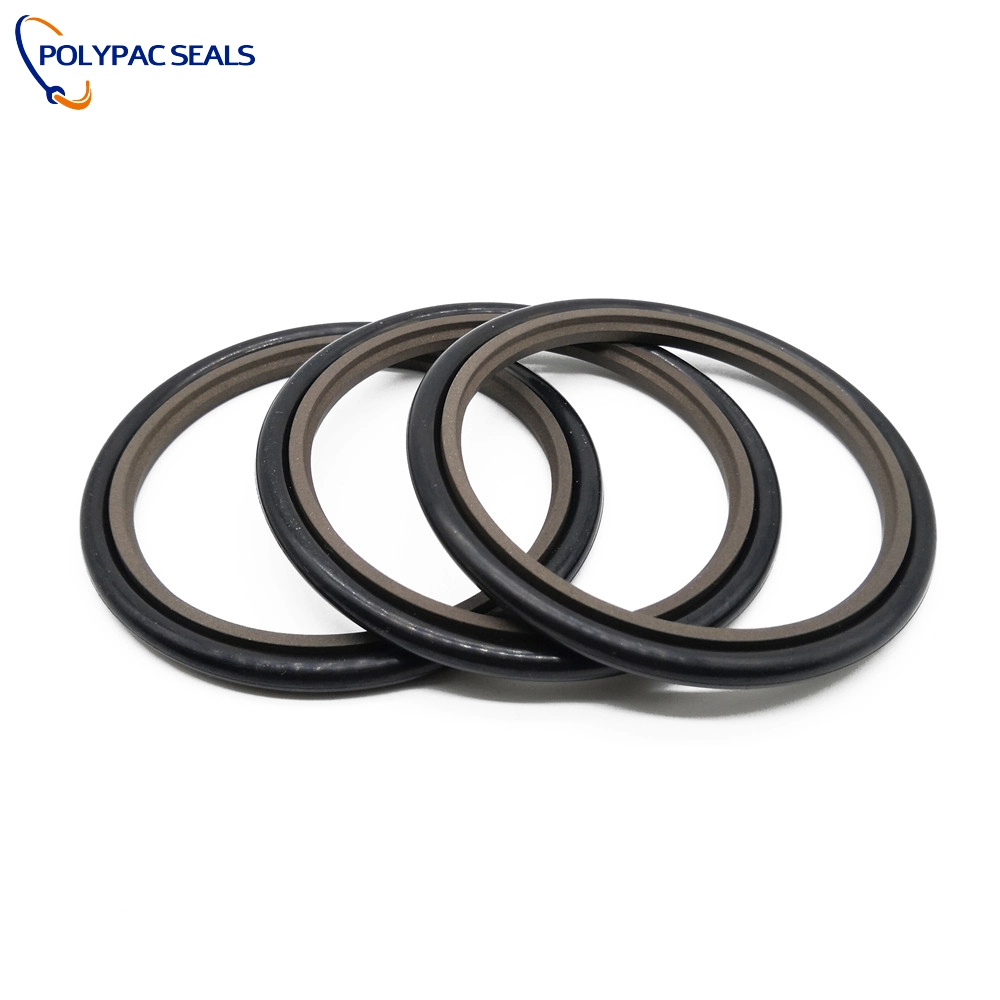
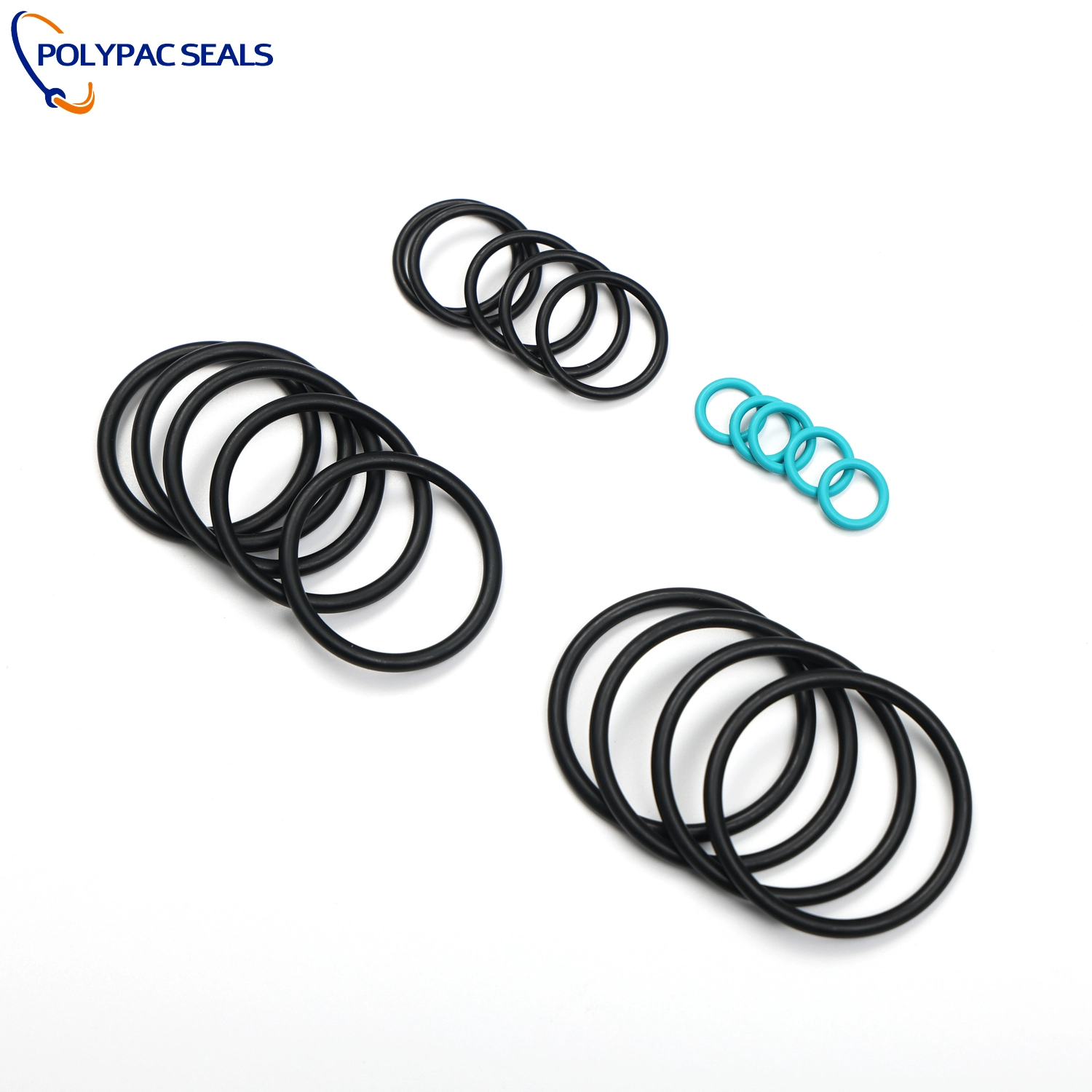
Polypac is a scientific and technical hydraulic seal manufacturer and oil seal supplier specializing in seal production, sealing material development, and customized sealing solutions for special working conditions. Founded in 2008, Polypac began by manufacturing filled PTFE seals (bronze-filled PTFE, carbon-filled PTFE, graphite PTFE, MoS₂-filled PTFE, and glass-filled PTFE). Today the company has expanded its product line to include O-rings made from NBR, FKM, silicone, EPDM, and FFKM.
Polypac's custom rubber ring and O-ring factory covers an area of more than 10,000 square meters, with a factory space of 8,000 square meters. Our production and testing equipment are among the most advanced in the industry. As one of the largest companies in China dedicated to the production and development of seals, we maintain long-term communication and cooperation with numerous universities and research institutions both domestically and internationally.
Key advantages of Polypac for customers selecting piston seal material:
- Material science capability — experience developing filled PTFE and elastomer compounds tailored to fluid, temperature and speed.
- Scale and quality control — large factory footprint with modern production and testing equipment for consistent batch performance.
- R&D partnerships — collaboration with universities and research institutes to translate lab data into robust field solutions.
- Broad product range and customization — O-Rings, Rod Seals, Piston Seals, End Face Spring Seals, Scraper Seals, Rotary Seals, Back-up Rings, Dust Rings.
- Ability to offer design support, prototype runs and life testing to validate piston seal material choices in customer-specific conditions.
If your application needs a long-life, low-friction piston seal for aggressive fluids or high temperature, Polypac's filled PTFE piston seals are a strong option. For conventional hydraulic systems where cost and elasticity matter, Polypac supplies standard and custom elastomer seals in NBR, FKM and other materials with quality assurance and testing documentation.
Selection checklist before ordering piston seals
Before placing an order for piston seals, confirm the following with your supplier:
- Operating temperature extremes (continuous and transient).
- Working fluid(s) and any expected contaminants.
- Pressure range and maximum pressure spikes.
- Stroke length, speed and duty cycle (dynamic vs static duty).
- Available gland space/extrusion gap and backup ring needs.
- Required certifications (e.g., FDA, RoHS) or material traceability.
- Sample testing plan and expected lead time for production parts.
FAQ — Frequently Asked Questions
1. Which piston seal material has the lowest friction?
PTFE (especially filled PTFE) typically has the lowest sliding friction coefficient and is preferred where energy loss, heat build-up or stick-slip must be minimized.
2. Can PTFE replace rubber seals in all hydraulic cylinders?
No. PTFE requires appropriate energizing (spring or O-ring), tighter finishing tolerances and careful gland design. In many low-cost hydraulic cylinders, elastomers remain the practical choice.
3. How do I prevent extrusion with a soft rubber piston seal at high pressure?
Use proper hardness selection, reduce extrusion gap, add backup rings (PTFE or reinforced polymer) and consider stepped pistons or metal guides to distribute load.
4. Are filled PTFE seals chemically compatible with aggressive hydraulic fluids?
Filled PTFE grades provide excellent chemical resistance to most hydraulic fluids and solvents. Always verify with specific fluid compatibility tests and supplier datasheets.
5. Which is more cost-effective over service life: PTFE or rubber?
It depends. PTFE has higher initial material and processing cost but can give longer life and lower maintenance in abrasive or chemically aggressive conditions. Elastomers are cheaper initially and easier to replace for benign service.
6. Do I need different surface finishes for PTFE vs rubber piston seal material?
Yes. PTFE typically requires a smoother surface finish (lower Ra) to minimize wear and ensure consistent sealing. Elastomers are more forgiving but still benefit from controlled finishes.
Contact and product inquiry
If you want help selecting the right piston seal material, testing prototypes or sourcing production seals, contact Polypac for technical consultation, samples and quotation. Polypac offers custom design, material selection support and testing to validate piston seal solutions under your real operating conditions. Visit our product pages or contact our sales engineers to request drawings, material datasheets and lead times.
References
- Polypac company profile and product overview — company information provided in brief (internal Polypac materials).
- Polytetrafluoroethylene (PTFE) — Wikipedia. https://en.wikipedia.org/wiki/Polytetrafluoroethylene (accessed 2025-11-30)
- SKF — Sealing solutions overview. https://www.skf.com/products/seals (accessed 2025-11-30)
- Parker O-Ring Handbook — material and design guidance (reference handbook). https://www.parker.com/literature/Oring/11095.pdf (accessed 2025-11-30)
- Chemours - Teflon (PTFE) product and technical information. https://www.chemours.com/en/brands/teflon (accessed 2025-11-30)
- Material property databases and elastomer temperature ranges — MatWeb and manufacturer datasheets (various compounds). https://www.matweb.com/ (accessed 2025-11-30)
For technical consultation or to request seals and prototype testing from Polypac, please contact our sales engineers via the Polypac website or email. We provide detailed material datasheets, test reports and custom designs for piston seals and associated sealing components.

High-Performance Pneumatic Piston Seals: How to Achieve Zero-Leakage Efficiency

PTFE vs. Composite: Choosing the Best Piston Guide Ring Material for High-Pressure Systems

Mastering O-Ring Gland Design: The Complete Guide for Perfect Sealing Performance

Advanced Back-Up Ring Materials: Beyond PTFE for Extreme Temperature Environments

PTFE vs. Urethane Scrapers: Which Material Truly Prevents Contamination?
Products
Can I reuse a seal?
What is the difference between a static seal and a dynamic seal?
How can I prevent seal damage during installation?
How important is surface finish on the metal parts that contact the seal?
How do I choose the right material for my sealing application?
Stay Updated with Industry Insights
Subscribe to our articles and receive the latest news, expert guidance, and technical updates directly in your E-mail.
Rest assured that your privacy is important to us, and all information provided will be handled with the utmost confidentiality.

Polypac is a trusted global supplier of high-performance sealing solutions, providing OEM & ODM services for industries worldwide.
E-mail:
Phone/WhatsApp:
© 2025 Polypac Seals. All Rights Reserved.
dms
DMS
DMS