












Quality Control: Inspection Standards for Piston Rubber Seals
Piston rubber seals are critical components in hydraulic and pneumatic cylinders. Effective quality control (QC) combines material verification, dimensional and mechanical testing, surface inspection, and functional leakage/dynamic tests to ensure reliable sealing performance under expected pressures, temperatures, and media. This article outlines the inspection standards and acceptance criteria you should apply for piston rubber seals to reduce field failures, control costs, and comply with common industry practices and standards.
Understanding seal function and operating context
Sealing roles: static vs dynamic
Piston rubber seals typically operate as dynamic seals (sliding on the piston rod/cylinder bore) and as static seals (mating faces or grooves). Dynamic piston seals must resist friction, extrusion, wear and maintain a fluid film; static seals must sustain compression without cold flow or relaxation. Understanding the working mode helps set inspection priorities: dynamic seals require stricter surface finish and profile checks, while static seals emphasize compression set and dimensional stability.
Operating environment and media compatibility
Validate the elastomer and any filler/PTFE composite for the expected temperature range, hydraulic fluid or gas, contaminants, and pressure. Common elastomers include NBR (nitrile rubber), FKM (fluoroelastomer), EPDM, silicone and FFKM; filled PTFE and specialty compounds can be specified for high-temperature or aggressive media. For material reference and properties, see the relevant technical overviews on NBR, FKM, and PTFE.
Design and tolerance implications
Piston seal cross-section, lip geometry, and groove clearance directly influence leakage and life. Inspection must verify that manufactured cross-sections match design within specified tolerances (typically ±0.05–0.2 mm depending on size). Groove dimensions and surface roughness of mating parts should also be controlled—excessive roughness or dimensional mismatch leads to extrusion or accelerated wear.
Common failure modes and root causes
Leakage and extrusion
Leakage is the most visible failure. Causes include wrong material selection, improper hardness, incorrect lip geometry, groove mismatch, and extrusion due to inadequate back-up support. Extrusion often occurs under high pressure when the seal deforms into clearances; back-up rings and correct lip profiling reduce this risk.
Wear, abrasion and surface damage
Contaminants, abrasive particles, or incompatible surface finishes accelerate lip wear. Typical inspection findings are scoring, nicks, flattened lips, and uneven wear patterns. Address via better filtration, improved scraper seals, and stricter incoming inspection for surface defects.
Compression set and material aging
Permanent deformation (compression set) reduces contact force and increases leakage. Elevated temperatures and chemical attack accelerate compression set. Use ASTM-based tests to quantify compression set and require certificates or batch testing for materials susceptible to aging. Guidance on polymer aging and testing practices is discussed in industry handbooks such as the Parker O-Ring Handbook.
Inspection methods and acceptance criteria
Visual and surface inspection
All seals should pass visual inspection: no surface cuts, flash, porosity, improper vulcanization or discoloration. Use 10–20× magnification for critical features. Surface finish of mating metal parts should be measured (e.g., Ra 0.2–0.8 µm for many dynamic seals); unacceptable roughness is a direct cause of abrasion and leakage.
Dimensional control: gauges and CMM
Dimensional inspection must include cross-section, inner/outer diameters, lip thickness, groove-fit dimensions and concentricity. For high-volume production, ring gauges, go/no-go fixtures and optical comparators are efficient. For complex profiles, use a coordinate measuring machine (CMM) or profile projector. Typical tolerance bands (example):
| Feature | Typical Tolerance | Measurement Method |
|---|---|---|
| Cross-section (mm) | ±0.05 — ±0.15 | micrometer / CMM |
| Inner/Outer Diameter (ID/OD) | ±0.05 — ±0.2 | ID/OD gauges, calipers |
| Lip thickness/profile | ±0.02 — ±0.1 | profile projector / optical CMM |
| Hardness (Shore A) | ±2–5 Shore A | Durometer (ASTM D2240) |
These ranges change with part size and application; agree tolerances in the technical drawing and inspection plan.
Mechanical and aging tests
Key mechanical tests include:
- Hardness (Shore A) — per ASTM D2240 reference
- Compression set — per ASTM D395 guidelines
- Tensile strength and elongation — per ASTM D412
Specify test conditions (temperature, time, percent deflection) matching expected service environment. Require certificates of conformity and, for critical lots, perform lab verification sampling.
Sampling, functional testing and continuous monitoring
Sampling plans and acceptance levels
Use statistically valid sampling for batch acceptance. Commonly used schemes include ISO 2859-1 (formerly MIL-STD-105) sampling plans to select sample sizes and acceptance numbers based on lot size and acceptable quality level (AQL). For critical seals, consider 100% inspection for key dimensions or reduced AQL (e.g., 0.65%). Reference: ISO 2859-1.
Functional leakage and pressure testing
Functional testing simulates service conditions. Typical tests:
- Hydrostatic pressure test: assemble seal in test fixture and apply working pressure plus a safety margin; inspect for leakage over a specified hold time.
- Dynamic cycle test: run the seal through expected stroke length, frequency and temperature for a defined number of cycles and monitor leakage and friction build-up.
- Air bubble/leak detection: submerge and apply pressure to detect micro-leaks.
Define pass/fail leakage rates or bubble counts in the inspection plan; e.g., no visible leakage after 30 minutes at rated pressure.
In-line quality monitoring and SPC
Implement statistical process control (SPC) on critical measurements such as diameter, hardness and profile. Track trends to detect drifting processes early. Use control charts and define corrective action triggers (e.g., 2σ or 3σ excursions).
Material considerations and comparative guide
Common elastomers and their test priorities
When inspecting seals, material properties dictate which tests are most important. For example, NBR is widely used for hydraulic seals for oil resistance and good mechanical properties, FKM offers high-temperature and chemical resistance, EPDM is good for water/steam but not hydrocarbon oils, and FFKM is for extreme chemical resistance and high temperature. Filled PTFE products are used where low friction and high-temperature stability are required.
Material comparison table
Typical comparative properties (approximate ranges and behaviors; verify with supplier datasheets):
| Material | Temp Range (°C) | Best For | Weaknesses | Reference |
|---|---|---|---|---|
| NBR (Nitrile) | -40 to +120 | Hydraulic oil, good wear resistance | Poor ozone/weather/fluids with polar solvents | Wikipedia |
| FKM (Viton) | -20 to +200 | High temp, fuels, oils, chemicals | Costly; limited low-temp elasticity | Wikipedia |
| EPDM | -50 to +150 | Steam, hot water, brake fluid | Poor hydrocarbon oil resistance | Wikipedia |
| Silicone | -60 to +200 | High/low temp, food/medical (selected types) | Poor tear resistance and high compression set | Wikipedia |
| FFKM | -20 to +300 | Extreme chemicals and temperatures | Very expensive | Wikipedia |
| PTFE (filled) | -200 to +260 | Low friction, chemical inertness | Poor elasticity; requires energizing elastomer or special design | Wikipedia |
How to verify material batches
Request material certificates (CoA) and perform periodic lab verification: Fourier-transform infrared spectroscopy (FTIR) for compound verification, differential scanning calorimetry (DSC) for thermal properties, and shore hardness checks. For critical projects, require traceability to raw material lot numbers and supplier test certificates.
Supplier qualification, traceability and documentation
Quality system and standards
Prefer suppliers with documented quality systems (ISO 9001 certified) and experience in hydraulic seal manufacturing. Supplier technical literature and historical test data reduce qualification time. See general quality management guidance at ISO 9001.
Traceability and batch control
Maintain lot-level records linking incoming raw materials to finished seals and QC test results. This enables root cause tracing for field failures and supports warranty claims. Include production date, compound batch, molding press number, vulcanization cycle and inspection records.
Continuous improvement and field feedback
Collect field failure data, run root cause analysis (RCA) and feed corrective actions back into design and supplier controls. Common corrective actions include material changes, geometry updates, improved groove specifications, and changes to assembly practice (cleaning, lubrication, back-up rings).
Polypac: manufacturer profile and capabilities
Who Polypac is
Polypac is a scientific and technical hydraulic seal manufacturer and oil seal supplier specializing in seal production, sealing material development, and customized sealing solutions for special working conditions. Founded in 2008, Polypac started with filled PTFE seals (bronze-filled, carbon-filled, graphite PTFE, MoS₂-filled PTFE, glass-filled PTFE) and has expanded to comprehensive elastomer seal production.
Production scale and technical resources
Polypac's custom rubber ring and O-ring factory covers more than 10,000 square meters, with factory space of 8,000 square meters. Production and testing equipment are among the most advanced in the industry. Polypac maintains long-term communication and cooperation with universities and research institutions both domestically and internationally, ensuring ongoing material and process R&D.
Product range and competitive strengths
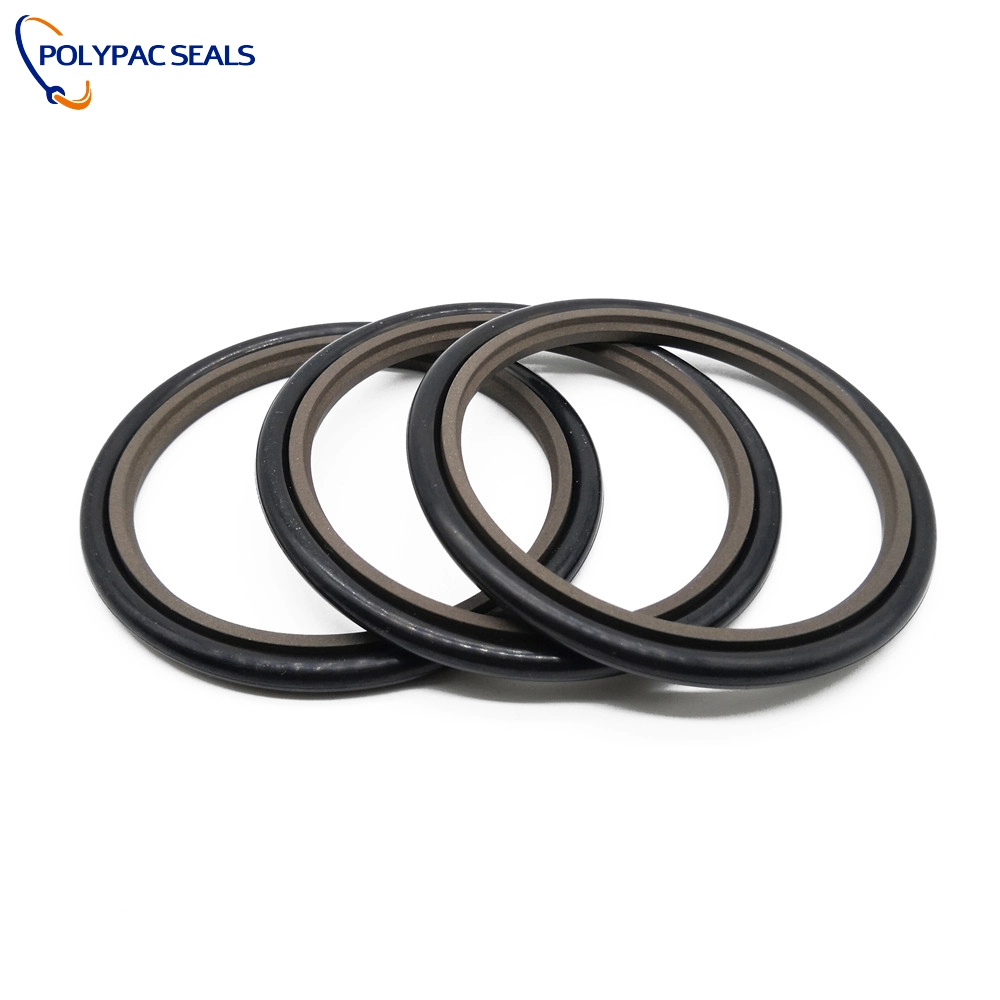
Polypac produces a wide range of sealing products, including O-Rings, Rod Seals, Piston Seals, End Face Spring Seals, Scraper Seals, Rotary Seals, Back-up Rings and Dust Rings. The company emphasizes:
- Technical depth in material development (filled PTFE and elastomer compounds)
- Advanced production/testing equipment enabling consistent dimensional and material control
- Customized sealing solutions for special operating conditions
- Strong R&D and academic collaborations supporting validated performance data
Best practices summary and implementation checklist
Inspection checklist for incoming and final seals
- Verify supplier CoA and material batch traceability.
- Perform visual inspection (no flash, cuts, deformation).
- Measure critical dimensions with calibrated tools (ID/OD, cross-section, lip thickness).
- Check hardness (Shore A) on representative samples.
- Run compression set and tensile tests on periodic samples.
- Conduct functional hydrostatic/dynamic leakage tests for critical applications.
- Apply SPC to monitor key process variables and trigger corrective action.
Action steps to reduce field failures
Design reviews with seal suppliers, stricter groove tolerance control, improved filtration and lab verification of materials are high-impact measures. Use back-up rings and correct clearance design to prevent extrusion in high-pressure systems.
FAQ
1. What are the most important tests for piston rubber seals?
Key tests: dimensional checks, Shore A hardness, compression set, tensile/elongation, and functional leakage (hydrostatic/dynamic). The priority depends on the application (dynamic vs static, pressure, temperature and media).
2. How often should I sample seals for destructive testing?
For production runs, perform sample destructive testing per an agreed schedule (e.g., first article, then per lot or weekly depending on volume). Use ISO 2859-1 sampling plans to determine sample size based on AQL and lot size.
3. Can filled PTFE replace elastomer piston seals?
Filled PTFE offers low friction and chemical resistance but lacks elasticity. It may replace elastomers in specific designs using energizers or special profiles, especially where temperature or chemical inertness is critical. Evaluate via prototype testing and functional cycles.
4. What hardness is typical for piston seals?
Typical piston seals are in the 70–90 Shore A range for many hydraulic applications. Softer compounds reduce friction but may increase extrusion risk; choose hardness based on groove design and operating pressure.
5. How do I interpret a compression set report?
Compression set indicates the permanent deformation after defined compression/time/temperature. Lower numbers indicate better recovery. Compare measured values against supplier specs and expected service temperatures; high compression set suggests premature loss of sealing force.
6. How should I qualify a new seal supplier?
Require ISO-registered quality management, material CoAs, first-article inspection reports, sample mechanical testing, and a trial batch with functional testing. Request references for similar hydraulic applications.
Contact and product inquiry
If you need professional support with piston rubber seal specification, sampling plans or customized sealing solutions, Polypac provides technical consulting, custom compound development and volume production. View Polypac's product offerings including O-Rings, Rod Seals, Piston Seals, End Face Spring Seals, Scraper Seals, Rotary Seals, Back-up Rings and Dust Rings, and request a quote or test samples by contacting their sales/technical team.
For technical collaboration, certifications, or ordering, contact Polypac through their official channels and request detailed material datasheets, test protocols and traceability documentation to match your application requirements.

High-Performance Pneumatic Piston Seals: How to Achieve Zero-Leakage Efficiency

PTFE vs. Composite: Choosing the Best Piston Guide Ring Material for High-Pressure Systems

Mastering O-Ring Gland Design: The Complete Guide for Perfect Sealing Performance

Advanced Back-Up Ring Materials: Beyond PTFE for Extreme Temperature Environments

PTFE vs. Urethane Scrapers: Which Material Truly Prevents Contamination?
Products
What does "AS568" mean?
Why did my O-ring fail prematurely?
How important is surface finish on the metal parts that contact the seal?
What is the difference between a static seal and a dynamic seal?
Can I reuse a seal?
Stay Updated with Industry Insights
Subscribe to our articles and receive the latest news, expert guidance, and technical updates directly in your E-mail.
Rest assured that your privacy is important to us, and all information provided will be handled with the utmost confidentiality.

Polypac is a trusted global supplier of high-performance sealing solutions, providing OEM & ODM services for industries worldwide.
E-mail:
Phone/WhatsApp:
© 2025 Polypac Seals. All Rights Reserved.
dms
DMS
DMS