












AS568 vs. Metric O-Ring Specifications: Choosing the Right Fit for Extreme Applications in 2026
What are O-Ring Size Specifications?
O-ring size specifications are precise dimensional standards used to categorize sealing rings, defined primarily by the Inner Diameter (ID) and Cross-Sectional (CS) diameter. These specifications ensure a proper geometric fit within a machine gland to maintain an effective seal under varying pressures.
When engineering a hydraulic or pneumatic system, understanding these dimensional frameworks is absolutely vital. The AS568 o-ring dimensions and metric sizing systems govern how much the elastomer will compress and stretch once installed. Without a standardized sizing specification, determining the precise volume fill and hardware clearances would be impossible, leading to catastrophic system leaks and mechanical failures.
- Dimensional Accuracy: These specifications ensure a proper geometric fit within a machine gland to maintain an effective seal under varying pressures.
- Performance Predictability: They dictate the precise amount of stretch and compression required for optimal functionality.
- System Separation: The two most dominant global sizing systems are the Imperial AS568 standard and international Metric standards, such as ISO 3601.
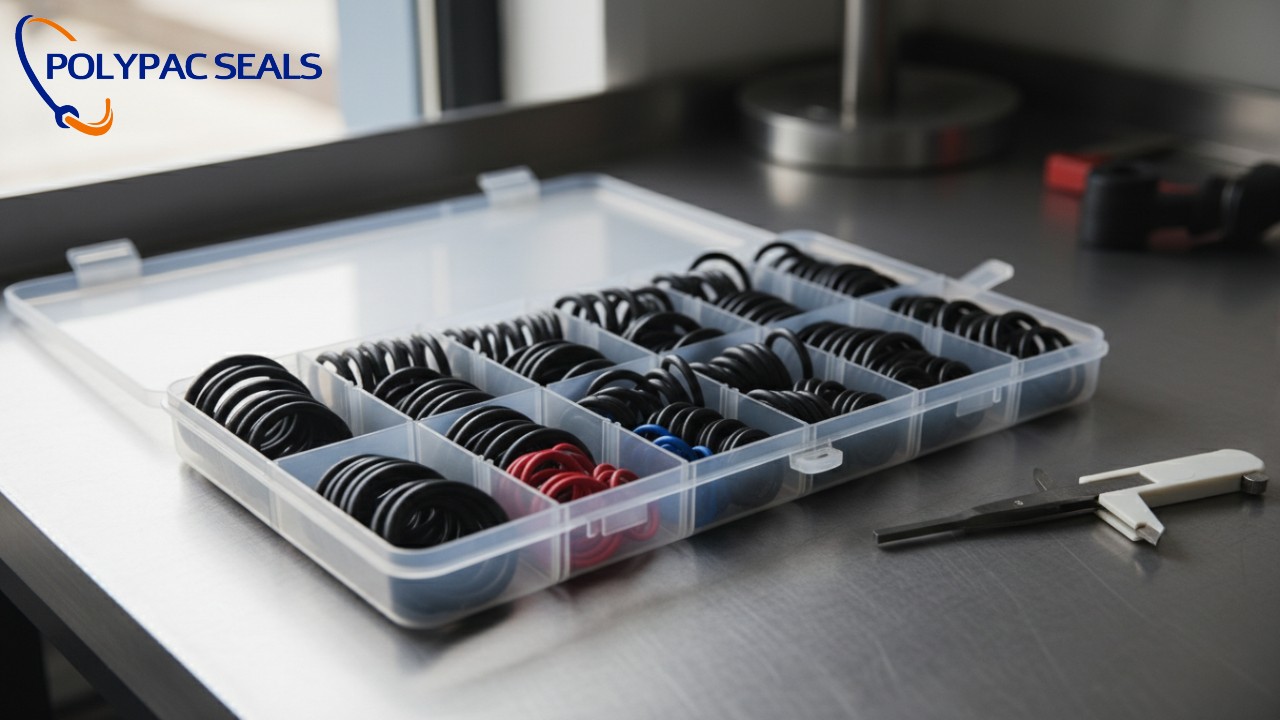
Key Takeaways: Quick Summary of AS568 vs. Metric Systems
The primary difference between the two systems is that AS568 is a US-based standard utilizing inch-based fractional measurements and specific dash numbers, while metric sizes offer a granular range of dimensions specified in millimeters for global manufacturing.
When comparing ISO 3601 vs AS568, engineers must carefully evaluate the origin of the equipment and the intended operating environment. Imperial and metric sizes are rarely interchangeable because their cross-sectional thicknesses do not perfectly align. Attempting to force a poorly matched seal into a rigid metal gland will result in improper compression.
- AS568 Standard: AS568 is the US Aerospace Standard utilizing inch-based fractional measurements and specific dash numbers.
- Metric Standards: Metric sizes (ISO 3601, DIN 3771, JIS) offer a granular range of dimensions specified in millimeters, ideal for global manufacturing.
- Critical Precision: Precision in sizing dictates the exact squeeze and stretch required to prevent mechanical failure in extreme environments.
Deep Dive: The AS568 O-Ring Standard
AS568 is the recognized Aerospace Size Standard published by SAE International, defining exact inch-based inside diameters, cross-sections, tolerances, and size identification codes to standardize seal procurement across North American manufacturing.
First introduced decades ago, the AS568 o-ring dimensions system revolutionized the sealing industry by categorizing O-rings into distinct series based on their cross-sectional thickness. For example, the 000 series features a 0.070-inch cross-section, the 100 series features a 0.103-inch cross-section, and the 200 series features a 0.139-inch cross-section. This standardized dash system allows engineers and procurement teams to easily identify, order, and replace seals without complex manual measurements.
- Standardized Adoption: Understanding the Aerospace Size Standard (AS568) and its widespread adoption in North American manufacturing is crucial for domestic OEMs.
- Dash Number System: Decoding the dash number system (e.g., -012, -214) correlates directly to standard cross-sections and internal diameters.
- Economic Advantages: The benefits of standardizing with AS568 include vast inventory availability and significant replacement cost reduction.
Metric O-Ring Specifications: ISO 3601, DIN, and JIS
Metric O-ring specifications classify seals using exact millimeter measurements, with the widely adopted International Organization for Standardization ISO 3601 standard providing global consistency for fluid power systems and general industrial applications.
In today's highly globalized economy, navigating metric standards is non-negotiable. While ISO 3601 is the most prominent, engineers may also encounter the Japanese Industrial Standard (JIS B2401) or the German Standard (DIN 3771). Understanding exact metric o-ring tolerances is essential because ISO 3601 is divided into two distinct classes. Class A provides tighter tolerances for aerospace and critical industrial applications, whereas Class B offers standard tolerances for general-purpose equipment.
- Global Standardization: Navigating international metric standards focuses heavily on the globally recognized ISO 3601 system.
- Regional Variations: Comparing Japanese Industrial Standards (JIS B2401) and British Standards (BS 4518) to modern European metric sizing ensures proper cross-referencing.
- Modern OEMs: Knowing when to opt for metric sizes over imperial is critical, particularly in modern, globally sourced OEM equipment.
Sizing for Extreme Applications: High Pressure, Heat, and Chemicals
Sizing O-rings for extreme conditions requires calculating precise thermal expansion, chemical swell, and structural extrusion limits to ensure the seal maintains its integrity without overfilling the hardware gland.
Extreme environments demand meticulous engineering. Under intense heat, elastomers exhibit a high coefficient of thermal expansion, meaning the physical volume of the seal will increase significantly. If the gland design does not accommodate this expansion, the seal will extrude, fracture, or suffer from explosive decompression. Selecting appropriate extreme temperature o-ring materials, such as perfluoroelastomers (FFKM), ensures the seal retains its dimensional stability even when subjected to harsh, aggressive chemicals.
- Thermal Dynamics: Extreme thermal expansion and contraction alter actual O-ring dimensions versus their nominal size specifications.
- Pressure Management: Adjusting cross-sectional squeeze and volume fill for high-pressure systems is necessary to prevent extrusion and explosive decompression.
- Advanced Elastomers: The impact of advanced extreme temperature o-ring materials (like FFKM and PTFE) on dimensional tolerances in harsh chemical environments cannot be overstated.
Expert Tips & Common Mistakes in O-Ring Sizing
The most catastrophic mistake in O-ring sizing is measuring a used, deformed seal instead of the rigid metal gland, which inherently leads to inaccurate dimensional data and subsequent mechanical failures.
Because elastomers undergo compression set—permanently taking the shape of the gland after prolonged exposure to heat and pressure—measuring an old seal is highly unreliable. Instead, engineers must execute a precise o-ring squeeze calculation using the hard dimensions of the piston and bore. Furthermore, engineers must account for tolerance stacking, ensuring that even at maximum material conditions, the seal functions properly.
- Mistake: Measuring a used O-ring. Always calculate the required size based on the hard gland geometry, as used elastomers suffer from compression set.
- Tip: Pay close attention to tolerance stacking. Ensure the maximum O-ring volume does not exceed 90% of the gland volume to allow for thermal expansion.
- Mistake: Assuming a close-enough metric O-ring can seamlessly replace an AS568 dash size without altering the required o-ring squeeze calculation.
Industry Leading Solution: Optimizing Seal Performance
Achieving optimal seal performance requires partnering with an advanced manufacturer that combines precise engineering, extensive material science, and rigorous testing to match the exact dimensional standards of your application.
Since 2008, Polypac Industrial Technology Co.,Ltd has operated as a premier scientific and technical hydraulic seal manufacturer. Operating out of a massive 10,000-square-meter facility with industry-leading production and testing equipment, we develop customized sealing solutions for the most brutal working conditions. From our origins in bronze and carbon-filled PTFE seals to our current advancements in NBR, FKM, silicone, EPDM, and FFKM, we understand the critical nuances of both imperial and metric tolerances.
- Expert Sourcing: Sourcing high-performance O-rings requires partnering with a specialized custom o ring manufacturer who understands both AS568 and international metric tolerances.
- Advanced Engineering: Through rigorous testing and academic partnerships, Polypac provides precision-matched sealing solutions for the most demanding applications.
- Proven Case Study: Identifying the precise ISO 3601 specification over a mismatched AS568 standard successfully prevented catastrophic seal failure in a high-pressure offshore drilling rig.
Conclusion & Call to Action
Choosing between AS568 and Metric O-ring specifications ultimately depends on your exact gland geometry, operating pressures, and regional equipment origins.
Whether you are designing a high-pressure hydraulic actuator or outfitting a chemical processing plant, dimensional accuracy cannot be ignored. Ensuring the correct cross-section, proper stretch limits, and an optimized material profile is the only way to maintain an effective, leak-free seal in extreme applications.
Contact Polypac today to discuss your specific custom sealing needs.
Frequently Asked Questions (FAQ)
How do you measure O-ring size specifications?
You measure O-ring specifications by determining the exact Inner Diameter (ID) and the Cross-Section (CS) using precise measuring instruments designed for elastomers.
- O-rings are measured precisely by their Inner Diameter (ID) and Cross-Section (CS).
- It is best to use precise measuring tools like a Pi tape, sizing cone, or digital calipers.
- Always measure the rigid gland dimensions rather than an old, deformed O-ring.
What is the difference between AS568 and metric O-rings?
The primary difference is the measurement system: AS568 relies on imperial inches and standardized dash numbers, while metric O-rings use precise millimeters based on global standards.
- AS568 is a standard developed in the US using inch measurements and categorized by 'dash numbers'.
- Metric O-rings are measured strictly in millimeters and conform to international standards like ISO 3601 or DIN 3771.
- Their cross-sectional thicknesses rarely align perfectly, making them fundamentally non-interchangeable.
Can I use a metric O-ring in an AS568 groove?
It is highly advised against using a metric O-ring in an AS568 groove because mismatched cross-sectional tolerances will severely compromise the required squeeze and system integrity.
- It is generally not recommended because the cross-sectional thickness and tolerances will differ.
- Using an improper size can lead to too little squeeze (causing leaks) or too much squeeze (causing premature wear and extrusion).
- Always match the O-ring to the specific, engineered gland design.
What happens if an O-ring has too much stretch?
Excessive stretch artificially thins the cross-section of the O-ring, severely reducing its ability to compress against the gland walls and maintain an effective seal.
- Excessive stretch reduces the cross-section (CS) of the O-ring through the volume conservation principle.
- This reduction in thickness limits the squeeze against the gland walls, significantly increasing the risk of leakage.
- Industry standards recommend a maximum inner diameter stretch of 5% for most applications.
How do you calculate O-ring squeeze for extreme pressures?
You calculate O-ring squeeze by subtracting the gland depth from the O-ring cross-section, and then dividing that figure by the original cross-section to find the compression percentage.
- Squeeze is calculated by subtracting the gland depth from the O-ring cross-section, divided by the cross-section.
- For extreme high-pressure dynamic seals, a lower squeeze (10-15%) minimizes rotational or reciprocal friction.
- For extreme high-pressure static seals, a higher squeeze (up to 30%) is used to prevent gap extrusion.
What is the ISO 3601 standard for O-rings?
ISO 3601 is the globally recognized international standard for metric O-rings, defining specific dimensions, tolerance classes, and quality acceptance criteria for modern applications.
- ISO 3601 is the most widely used international standard for metric O-rings.
- It specifies the inside diameters, cross-sections, tolerances, and size identification codes.
- It ensures global consistency across manufacturing and engineering sectors, bridging regional gaps.
Why should you never measure a used O-ring for replacement?
You should never measure a used O-ring because heat, pressure, and chemicals cause irreversible physical deformation known as compression set, rendering the measurements completely inaccurate.
- Used O-rings have been continuously subjected to heat, pressure, and chemical exposure.
- They permanently deform over time, taking on the shape of the gland (compression set) or swelling.
- Measuring them will result in incorrect dimensions and inevitably lead to a faulty replacement.
How do temperature changes affect O-ring dimensions?
Extreme temperature shifts cause elastomer O-rings to physically expand in heat or contract in the cold, drastically altering the seal's effective volume and functional squeeze.
- Elastomers have a high coefficient of thermal expansion, meaning they swell significantly when heated.
- If the gland design does not account for this expansion (volume fill exceeding 90%), the O-ring will extrude or fracture.
- In extreme cold, O-rings shrink, which directly reduces squeeze and can cause immediate, catastrophic leakage.


Products
How do I choose the right material for my sealing application?
What does "AS568" mean?
What is the purpose of the metal spring in a rotary shaft seal?
What is the difference between a static seal and a dynamic seal?
How can I prevent seal damage during installation?
Stay Updated with Industry Insights
Subscribe to our articles and receive the latest news, expert guidance, and technical updates directly in your E-mail.
Rest assured that your privacy is important to us, and all information provided will be handled with the utmost confidentiality.

Polypac is a trusted global supplier of high-performance sealing solutions, providing OEM & ODM services for industries worldwide.
E-mail:
sales2@dmsseals.com
Phone/WhatsApp:
© 2025 Polypac Seals. All Rights Reserved.
dms
DMS
DMS