











Hydraulic Wear Rings: The Complete Guide to Cylinder Performance & Longevity | Polypac
Hydraulic Wear Rings: The Unsung Heroes of Cylinder Reliability and Performance
In the powerful world of hydraulic cylinders, attention is often focused on the seals—the components that directly contain pressure. However, the silent partner ensuring those seals can do their job effectively is the hydraulic wear ring. This critical, yet frequently overlooked, component is the foundation upon which cylinder reliability, efficiency, and longevity are built. A cylinder without a proper wear ring is a system destined for premature failure, no matter how good its seals may be.
At Polypac, with our ISO 9001 & IATF 16949 focus on engineered solutions, we understand that a holistic sealing system is more than just the sealing elements. This guide explores the indispensable role of the hydraulic wear ring, how it functions, and why its correct specification is a non-negotiable aspect of optimal cylinder design and maintenance.
What is a Hydraulic Wear Ring?
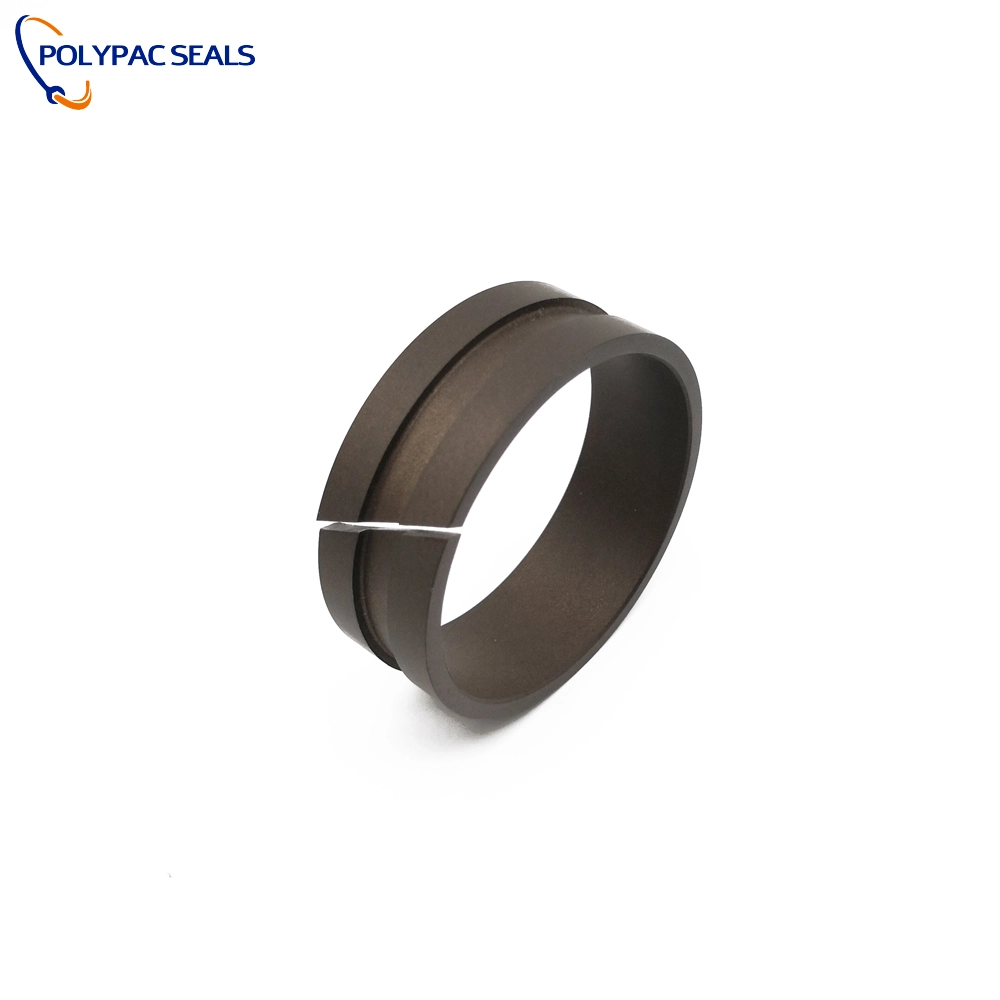
A hydraulic wear ring (also known as a guide ring, wear band, or bearing ring) is a low-friction, high-strength polymer component installed on the piston and/or in the rod gland of a hydraulic cylinder. It is not a seal; its primary function is mechanical, not fluid containment.
Its core missions are:
-
Radial Load Support: To absorb side loads and forces, preventing the metal piston or rod from contacting the metal cylinder bore or gland.
-
Alignment & Guidance: To keep the piston and rod perfectly centered within their bores, ensuring smooth, straight-line motion.
-
Wear Surface: To provide a sacrificial, low-friction sliding surface, protecting the expensive, precision-machined metal components from wear and scoring.
Why Are Wear Rings Absolutely Essential? The Consequences of Omission
Operating a cylinder without a functional wear ring invites a cascade of failures:
-
Metal-to-Metal Contact: The hardened steel piston or rod grinds directly against the cylinder tube, leading to rapid galling, scoring, and irreversible damage to both surfaces.
-
Seal Destruction: Misalignment causes uneven, asymmetric loading on seals. This leads to localized extrusion, rapid lip wear, and ultimately, seal blow-out and fluid leakage.
-
Increased Friction & Stick-Slip: Without a low-friction interface, the cylinder requires more energy to move and may exhibit jerky, unpredictable motion (stick-slip), especially at low speeds.
-
Catastrophic Failure: In severe cases, binding or scoring can lead to a seized piston or a bent rod, resulting in complete cylinder failure and costly downtime.
Key Functions and Benefits in Detail
1. Load Bearing and Stability
Wear rings are designed with a large bearing surface area to distribute side loads evenly across the cylinder wall. This prevents localized stress points and maintains system stability under heavy or off-center loads common in construction and industrial machinery.
2. Friction Reduction and Smooth Operation
Made from engineered polymers with inherent lubricity, wear rings dramatically reduce the coefficient of friction between moving parts. This translates to smoother cylinder operation, lower energy consumption, and reduced heat generation.
3. Contaminant Embedment
Certain wear ring materials are designed to allow fine abrasive particles to become embedded below the surface. This prevents these particles from circulating and scoring the cylinder wall or rod—a crucial feature in dirty environments like mining or agriculture.
4. Thermal and Dimensional Management
Advanced polymer compounds maintain their dimensions and properties across a wide temperature range, ensuring consistent clearance and performance whether the cylinder is cold or at operating temperature.
Critical Material Selection for Hydraulic Wear Rings
The choice of material is paramount and depends on the application's specific demands for load, speed, temperature, and environment.
1. PTFE (Polytetrafluoroethylene) Composites
-
Properties: Exceptionally low friction, excellent chemical resistance, wide temperature range.
-
Common Fillers: Bronze (for high load and thermal conductivity), Glass (for wear resistance), Carbon/Graphite (for low friction and conductivity).
-
Polypac Advantage: We offer a range of filled PTFE compounds optimized for different PV (Pressure-Velocity) values and environmental conditions.
2. High-Performance Thermoplastic Polyesters (e.g., PETP)
-
Properties: Outstanding mechanical strength, excellent wear and abrasion resistance, low moisture absorption, good dimensional stability.
-
Polypac Advantage: Our engineered thermoplastic wear rings offer a superior balance of strength and wear life for general heavy-duty industrial applications, often outperforming standard materials.
3. Fabric-Reinforced Phenolics
-
Properties: Extremely high load-bearing capacity, excellent resistance to deformation under extreme pressure.
-
Ideal For: The most demanding applications, such as large mill-type cylinders in metal forming or heavy press machinery.
4. Polyamide (Nylon)
-
Properties: Good general strength, wear resistance, and impact toughness; cost-effective.
-
Consideration: Can absorb moisture, which affects dimensions; best for controlled environments.
Design and Installation: Solid vs. Split Rings
-
Solid Wear Rings: Used in smaller cylinders or where the piston can be easily disassembled from the rod. They provide continuous, uniform support.
-
Split Wear Rings: Feature a single cut, allowing them to be installed into a piston groove without disassembling the piston from the rod. This is a critical maintenance advantage for large-bore cylinders, drastically reducing downtime during rebuilds.
The Polypac Advantage: More Than a Component, a System Enhancer
We view wear rings as an integral part of the total sealing system.
-
Precision Engineering: Our wear rings are manufactured to precise tolerances to ensure optimal running clearance—too tight causes friction, too loose reduces guidance effectiveness.
-
Material Expertise: We select or formulate the polymer compound that provides the ideal balance of low friction, high load capacity, and long wear life for your specific operating conditions.
-
Complete System Kits: For cylinder rebuilds, we provide kits that include the correctly sized wear rings alongside all necessary seals (piston, rod, wiper), ensuring all components are designed to work in harmony for maximum service life.
Conclusion
The hydraulic wear ring is the fundamental guardian of cylinder health. It is the component that enables seals to function as designed, protects capital investment in precision-machined parts, and ensures smooth, efficient, and reliable cylinder operation. Specifying a high-quality, application-appropriate wear ring is one of the most cost-effective reliability investments you can make for your hydraulic equipment.
Designing a new cylinder or planning a rebuild? Don't leave performance and longevity to chance. Contact Polypac's technical team today to specify the optimal hydraulic wear ring solution for your application.


Products
Why did my O-ring fail prematurely?
What is the difference between a static seal and a dynamic seal?
Can I reuse a seal?
What is the purpose of the metal spring in a rotary shaft seal?
When should I use a spring-energized seal instead of a standard elastomeric seal?
Stay Updated with Industry Insights
Subscribe to our articles and receive the latest news, expert guidance, and technical updates directly in your E-mail.
Rest assured that your privacy is important to us, and all information provided will be handled with the utmost confidentiality.
Polypac is a trusted global supplier of high-performance sealing solutions, providing OEM & ODM services for industries worldwide.
E-mail:
Phone/WhatsApp:
© 2025 Polypac Seals. All Rights Reserved.
dms
DMS
DMS