












Mastering Oil Seal Dimensions: Your Ultimate Guide to Selection and Performance
Oil seals, or rotary shaft seals, are vital for machine performance, but their effectiveness relies heavily on precise sizing. This comprehensive guide breaks down the critical aspects of oil seal dimensions, including Inside Diameter (ID), Outside Diameter (OD), and Width. We explore the differences between imperial and metric systems, offer step-by-step instructions for accurate measurement, and decode complex part numbers. Whether replacing a worn seal or designing a new application, this article ensures you select the perfect seal to prevent leaks and maximize longevity.
Oil seals, technically known as rotary shaft seals, are the unsung heroes of industrial machinery and automotive engines. While they may appear to be simple components, their role is fundamental: they retain lubricants within a system while excluding contaminants like dust, dirt, and water. However, the most robust material or advanced lip design is rendered useless if the physical fit is incorrect. This brings us to the critical importance of oil seal dimensions.
Precise dimensional accuracy is the cornerstone of sealing effectiveness. A seal that is even a fraction of a millimeter off can lead to catastrophic leaks, shaft damage, or complete system failure. In this guide, we will journey through everything you need to know about mastering oil seal dimensions—from understanding the core measurements and navigating sizing systems to selecting the right material for your specific application requirements.
The Key Dimensions of an Oil Seal: ID, OD, and Width Explained
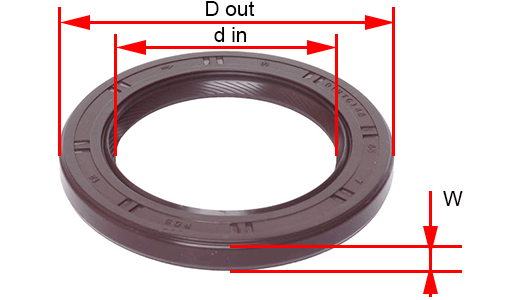
When identifying an oil seal, three primary dimensions define its geometry. Understanding these is the first step toward accurate selection.
1. Inside Diameter (ID) / Shaft Diameter
The Inside Diameter (ID) is arguably the most critical dimension. It corresponds directly to the diameter of the shaft the seal will run on. Unlike the housing, the seal's ID is designed to be slightly smaller than the shaft diameter to create an interference fit. This "squeeze" ensures that the primary sealing lip maintains constant contact with the rotating shaft, even under varying temperatures and speeds. When you see an oil seal size listed, the ID represents the shaft size it is intended to fit, not the actual relaxed measurement of the seal lip itself, which is flexible.
2. Outside Diameter (OD) / Housing Bore Diameter
The Outside Diameter (OD) of the oil seal must match the diameter of the housing bore (the hole where the seal is pressed). The OD is typically manufactured with a slight interference fit relative to the bore to ensure the seal remains static during operation. If the OD is too small, the seal will spin within the housing, causing leaks around the periphery. If it is too large, it may deform during installation or crack the housing.
3. Width (W) / Axial Thickness
The Width (W), sometimes referred to as height or thickness, refers to the total axial length of the seal. This dimension is crucial for ensuring the seal fits completely within the housing groove without protruding, which could interfere with other components like bearings or retaining rings. In some cases, a narrower seal can be used in a wider groove, but a seal that is wider than the groove is generally unusable.
Navigating Imperial vs. Metric Oil Seal Measurement Systems
One of the most common sources of confusion in oil seal selection is the existence of two predominant measurement systems: Imperial (Inch) and Metric (Millimeter).
- Metric Oil Seal Dimensions: These are the global standard for most modern machinery. Dimensions are expressed in millimeters (mm). Standard metric sizes often adhere to international standards such as DIN 3760 and ISO 6194. Part numbers for metric seals usually follow a logical sequence, such as 35x55x8, representing 35mm ID, 55mm OD, and 8mm Width.
- Imperial Oil Seal Sizes: Common in older machinery, American-made equipment, and specific aerospace applications, these are measured in inches and fractions of an inch. An imperial seal might be listed as 1.250 x 2.000 x 0.375.
The Golden Rule: Never assume. Always measure to confirm the system. While conversion is possible (1 inch = 25.4 mm), rounding errors can lead to selecting a seal that is "close enough" but functionally inadequate. It is highly recommended to replace an imperial seal with an imperial equivalent and a metric seal with a metric one to ensure the precise tolerances dictated by the original equipment manufacturer (OEM) are met.
How to Accurately Measure Existing Oil Seals and Application Points
To find the correct replacement, you need accurate data. This requires the right tools and a methodical approach.
Essential Tools
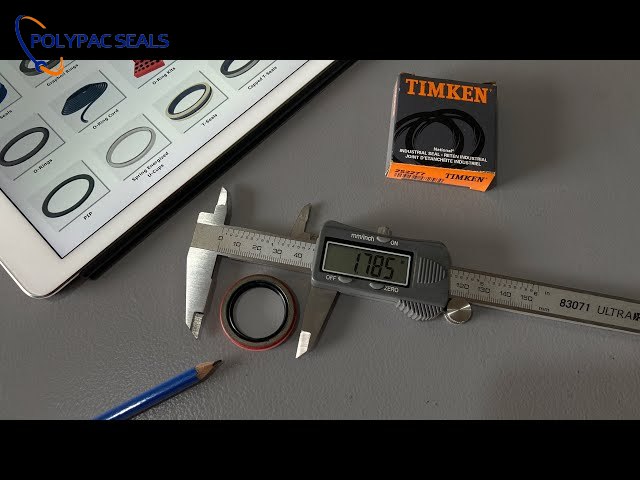
Put away the tape measure or standard ruler. For oil seal dimensions, you need precision. Digital Vernier calipers are the industry standard tool for this job. For extremely high-precision shaft measurements, a micrometer is preferred.
Measuring the Shaft and Bore (Best Practice)
The most accurate way to size a seal is not to measure the old seal, but to measure the hardware it fits onto.
- Measure the Shaft Diameter: Measure the shaft where the seal lip contacts it. Take measurements at three different points around the circumference to check for out-of-round conditions.
- Measure the Housing Bore: Measure the inside diameter of the housing groove. Again, measure at multiple points.
- Measure the Bore Depth: Ensure the groove is deep enough to accommodate the seal width.
Measuring an Existing (Old) Seal
If the machine is disassembled and you only have the old seal:
- ID: Be careful. The lip of a used seal is often worn or swollen from fluid absorption. Furthermore, the uninstalled lip diameter is naturally smaller than the shaft size. Measuring the ID of an old seal is often an estimation. It is safer to rely on the part number stamped on it or measure the shaft.
- OD: Measure the steel casing or rubber exterior. Take an average of three measurements.
- Width: Simply measure the thickness of the seal.
Note on Surface Finish: The shaft's surface finish (roughness, measured in Ra) is critical. A shaft that is too smooth may not retain enough lubrication under the lip, while a shaft that is too rough will grind the seal lip away. Standard shaft finishes for oil seals usually fall between 0.2 to 0.8 µm Ra.
Decoding Oil Seal Part Numbers and Markings
Oil seals almost always carry their identity stamped on the rubber face or metal case. Learning to read these codes can save you hours of measuring.
The Standard Format
The most common marking format is ID x OD x Width. For example, if you see 30 50 10, it refers to a 30mm Shaft, 50mm Bore, and 10mm Width.
Common Abbreviations and Lip Codes
Manufacturers often include codes indicating the design:
- SC / R21: Single Lip, Spring Loaded, Rubber Covered OD. Good for standard fluid retention.
- TC / R23: Double Lip (includes a secondary dust lip), Spring Loaded, Rubber Covered OD. This is the most common style, offering fluid retention and dust exclusion.
- SB / TB: Metal Case OD (instead of rubber covered). These require a messy sealant on the OD for a perfect seal in the housing.
Checking manufacturer catalogs or data sheets is vital when you encounter obscure codes, as proprietary naming conventions do exist.
Beyond Dimensions: Other Critical Factors for Oil Seal Selection
Finding a seal that fits physically is only half the battle. To ensure oil seal material compatibility and longevity, you must consider the operating environment.
Material Selection
Different elastomers handle heat and chemicals differently:
- Nitrile (NBR): The industry standard. Good for general-purpose oils and greases. Temperature range: -40°C to +120°C.
- Viton® (FKM): Excellent high-temperature and chemical resistance. Ideal for aggressive fuels and temperatures up to +200°C.
- Silicone (VMQ): Great for extreme cold and dry heat but poor mechanical strength. Often used in engines.
- PTFE (Teflon): Incredible chemical resistance and low friction, often used in dry-running or high-speed applications.
Lip Design and Application Conditions
- Pressure: Standard oil seals are designed for very low pressure (essentially zero). If your application involves high pressure, you need a specialized high-pressure seal with a reinforced cage.
- Shaft Speed: Higher speeds generate more heat at the lip contact point. You may need to upgrade from NBR to FKM if shaft speeds are high, even if the ambient temperature is low.
- Contaminants: If the environment is dirty or dusty, a double-lip (TC) design is non-negotiable. The secondary lip acts as a shield for the primary sealing lip.
-
Common Pitfalls and Troubleshooting with Oil Seal Dimensions
Even seasoned engineers can make mistakes with rotary shaft seal dimensions. Here are common pitfalls to avoid:
The "Close Enough" Trap
Using a generic imperial seal in a metric housing (or vice versa) because the dimensions seemed "close enough" usually results in leaks. A 0.5mm gap in the OD creates a leak path, while excessive interference causes heat buildup and rapid lip hardening.
Installation Damage
If the seal dimensions are correct but the seal fails immediately, check your installation method. Driving a seal in crooked or hammering directly on the sealing face can distort the dimensions. Always use a proper installation tool or a press fitting sleeve that applies force to the outer periphery of the seal.
Shaft Wear
If you replace a seal and it leaks again quickly, check the shaft. Over time, the old seal may have worn a groove into the shaft. Putting a new seal with standard dimensions back into that groove will result in failure. You may need a shaft repair sleeve (like a SKF Speedi-Sleeve) to restore the original shaft dimension.
Finding the Right Oil Seal: Utilizing Size Charts and Online Resources
Modern oil seal size charts are powerful tools. Most reputable distributors and manufacturers offer interactive online databases.
- Search by Dimension: Input your measured ID, OD, and Width ranges. The search engine will filter available stock.
- Cross-Reference: If you have a part number from a specific brand (e.g., SKF, Timken, NOK), use cross-reference tools to find equivalent seals from other manufacturers.
- Consult Experts: For critical applications involving high pressure, extreme acids, or unique housing shapes, custom-engineered solutions might be necessary. Don't hesitate to contact technical support.
Conclusion
Mastering oil seal dimensions is a blend of precision measurement and material science. While the concepts of Inside Diameter, Outside Diameter, and Width seem straightforward, the nuance lies in the precise matching of these figures to the application's shaft and bore. By adhering to industry standards, utilizing proper measuring tools, and considering environmental factors like temperature and chemical compatibility, you can ensure reliable, leak-free performance. Remember, a small investment in selecting the correctly sized seal today prevents costly downtime and repairs tomorrow.
FAQ
What are the three main dimensions to consider for an oil seal?
The three main dimensions are the Inside Diameter (ID), which matches the shaft diameter; the Outside Diameter (OD), which fits the housing bore; and the Width (W), which is the axial thickness of the seal.
Why is accurate measurement of oil seal dimensions so important?
Accurate measurement is crucial because an improperly sized oil seal can lead to leaks, premature wear, increased friction, and ultimately, system failure. A precise fit ensures optimal sealing and longevity.
How do I measure an oil seal if the markings are unreadable?
If markings are unreadable, you should carefully measure the seal's Inside Diameter (ID), Outside Diameter (OD), and Width using precision tools like Vernier calipers. It is also vital—and often more accurate—to measure the shaft diameter and housing bore dimensions of the application itself.
What is the difference between imperial and metric oil seal dimensions?
Imperial dimensions are measured in inches (e.g., 0.75" x 1.5" x 0.25"), while metric dimensions are measured in millimeters (e.g., 20mm x 35mm x 7mm). Many manufacturers provide charts with both systems or conversion tools, but it is best to stick to the system used by the original machine.
Do material type and lip design affect oil seal dimensions?
While material type (e.g., NBR, Viton) and lip design (single or double) do not change the fundamental ID, OD, and Width dimensions, they are critical selection factors. They work in conjunction with dimensions to ensure the seal's suitability for specific temperature, chemical, and pressure conditions.
What are common standards for oil seal dimensions?
Many standard oil seals comply with international standards such as DIN 3760 and ISO 6194, which specify acceptable dimensions and tolerances for rotary shaft lip seals. Consulting these standards can help ensure compatibility across different brands.
Can I use an oil seal that is slightly off in dimension?
Generally, it is not recommended to use an oil seal that is "slightly off" in dimension. Even small discrepancies can compromise the seal's interference fit, leading to leaks, excessive friction, or a shortened lifespan. Always aim for an exact match to the required dimensions.
Where can I find an oil seal size chart?
Oil seal size charts are widely available from manufacturers and distributors online. Many offer interactive charts that allow you to search by shaft diameter, housing bore, and width, often in both imperial and metric measurements.


Products
How do I choose the right material for my sealing application?
How can I prevent seal damage during installation?
Can I reuse a seal?
What does "AS568" mean?
What is the purpose of the metal spring in a rotary shaft seal?
Stay Updated with Industry Insights
Subscribe to our articles and receive the latest news, expert guidance, and technical updates directly in your E-mail.
Rest assured that your privacy is important to us, and all information provided will be handled with the utmost confidentiality.

Polypac is a trusted global supplier of high-performance sealing solutions, providing OEM & ODM services for industries worldwide.
E-mail:
Phone/WhatsApp:
© 2025 Polypac Seals. All Rights Reserved.
dms
DMS
DMS