












Metal vs. Composite: Which Hydraulic Guide Ring Increases Cylinder Life by 40%?
Quick Summary: The Shift to Composite Guide Rings
Composite guide rings differ from traditional metal bearings by utilizing elastic polymer structures that distribute radial loads more evenly, thereby preventing the cylinder scoring often caused by rigid metal-to-metal contact. This shift is driven by the need for longer service intervals and reduced cylinder wall damage.
While bronze and cast iron were once the industry standard, modern hydraulics demand materials that can handle higher pressures and misalignment without failure. The comparison of composite wear rings vs. metal bearings highlights a clear trend toward non-metallic solutions for the following reasons:
- Elasticity: Composites deform slightly under load, increasing the contact area and reducing point loading.
- Embeddability: Hard contaminants sink into the composite material rather than grinding against the cylinder bore.
- Service Life: High-performance composites can extend cylinder service life by up to 40% by eliminating metal transfer (galling).
- Lubrication: Self-lubricating properties ensure smooth operation even during dry starts.
What is a hydraulic guide ring, and why is material selection critical?
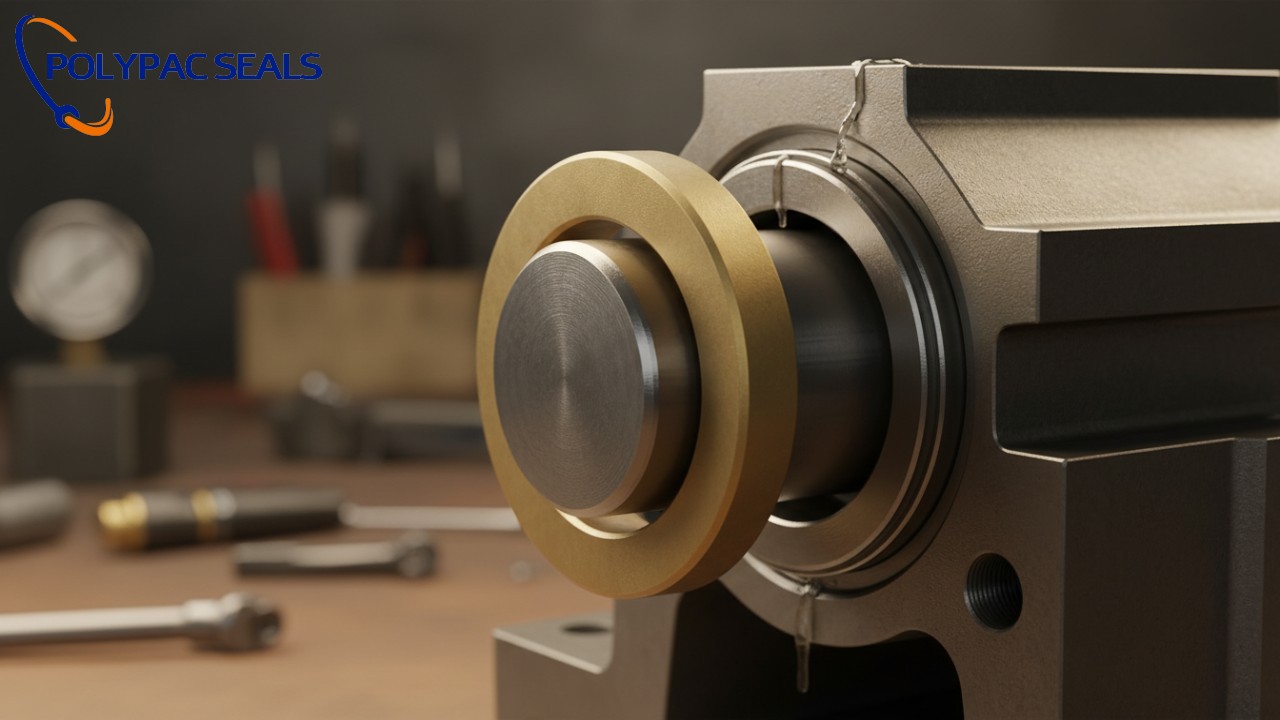
A hydraulic guide ring (or wear ring) is a sacrificial bearing element designed to center the piston and rod within a hydraulic cylinder, ensuring that radial loads are absorbed without compromising the integrity of the primary sealing elements. Its primary function is to prevent catastrophic metal-to-metal contact between moving parts.
Material selection is the single most critical factor in guide ring performance. Understanding the tribological properties of guide rings—specifically how they interact with the cylinder bore under friction—determines whether a system fails prematurely or runs for years. According to Machinery Lubrication, optimizing these tribological pairs is essential for preventing adhesive wear in hydraulic components.
Core Functions:
- Absorb Side Loads: Handles transverse forces caused by equipment misalignment or weight.
- Maintain Concentricity: Keeps the extrusion gap (E-gap) uniform to prevent seal failure.
- Protect Hardware: Acts as a fuse, wearing out sacrificially to save the expensive cylinder tube and rod.
Metal vs. Composite: The Ultimate Showdown
Metal bearings, such as bronze or cast iron, offer high load capacity but suffer from a high coefficient of friction and a lack of elasticity, which frequently leads to "galling" and permanent damage to cylinder walls during lubrication failure. In contrast, composite materials provide a forgiving, low-friction interface that dampens vibration.
When evaluating composite wear rings vs metal bearings, the performance gap becomes clear in heavy-duty applications:
-
Metal (Bronze/Iron):
- Pros: Extremely high static load capacity; good thermal conductivity.
- Cons: Rigid; zero embeddability (particles scour the bore); promotes oxidation/corrosion; requires precise lubrication to prevent seizure.
- Friction: Bronze typically exhibits a friction coefficient of 0.18–0.24 under starved lubrication, according to tribological studies published by MDPI.
-
Composites (Phenolic/PTFE/Polyester):
- Pros: High compressive strength (>340 MPa for reinforced grades); excellent embeddability of contaminants; chemically inert.
- Cons: Lower thermal conductivity than copper alloys (requires calculation of thermal expansion gaps).
- Friction: Significantly lower (<0.10), reducing heat generation and stick-slip ("stiction").
How Composite Rings Deliver a 40% Increase in Cylinder Life
Composite rings extend system longevity by utilizing elastic deformation to distribute stress over a wider contact patch, effectively eliminating the high-pressure peaks that cause localized scoring in rigid metal bearing systems. This "soft-touch" capability protects the mating hardware even under extreme side loads.
Modern thermoplastic bearing rings and thermoset composites function differently than metal:
- Elastic Deformation: Unlike metal, which stays rigid, composites flatten slightly under load. This increases the load-bearing area, reducing the PSI (pressure) at any single point.
- Elimination of Metal-on-Metal Contact: Even if the oil film breaks (boundary lubrication), the composite material touches the steel bore, preventing the welding/tearing damage associated with bronze-on-steel contact.
- Lubrication Retention: Many composite matrices include microscopic reservoirs that retain hydraulic fluid, ensuring hydrodynamic lubrication is maintained during start-stop cycles.
- Corrosion Resistance: Composites are immune to the galvanic corrosion that plagues metal bearings in marine or water-glycol environments.
Gap Analysis: Cost vs. Value (2026 Industry Outlook)
Total Cost of Ownership (TCO) analysis reveals that while metal bearings may have a lower purchase price, composite solutions deliver superior ROI by reducing cylinder refurbishment costs, minimizing downtime, and extending seal life. The initial savings of bronze are quickly lost when a cylinder bore requires rehoning.
Looking toward 2026, the industry is shifting toward phenolic resin guide tapes and reinforced synthetics due to environmental regulations:
- Biodegradable Fluids: As regulations push for bio-hydraulic fluids (which often have lower lubricity than mineral oils), the self-lubricating properties of composites are becoming mandatory.
- Sustainability: Composites reduce the mass of the cylinder and eliminate the need for grease in some applications.
- Retrofitting: Refurbishment centers are increasingly replacing bronze overlays with composite strips to modernize older equipment.
Expert Tips: Preventing Premature Guide Ring Failure
Premature failure in composite rings is most often caused by incorrect calculation of the "E-Gap" (extrusion gap) or neglecting thermal expansion rates, which are significantly higher for polymers than for metals. A ring that is too tight will expand with heat and seize the cylinder.
To ensure optimal performance, engineers must master the hydraulic cylinder side loading calculation:
- The 10-15% Rule: In many horizontal applications, assume that 10-15% of the hydraulic force transforms into radial (side) load due to weight and misalignment.
- Calculate the E-Gap: Adhere to standards like ISO 10766 for housing dimensions, ensuring the gap is sufficient to prevent metal contact but tight enough to prevent seal extrusion.
- Surface Finish (Ra): Ensure the mating surface is polished to the specific requirements of the composite (usually 0.4–0.8 µm Ra) to prevent abrasive wear.
- Cut Angles: Use angle cuts for reciprocating motion to allow fluid bypass; use step cuts only when minimal leakage is required (though guide rings are rarely used for sealing).
Case Study: Achieving Superior Durability with Polypac Solutions
Polypac Industrial Technology recently analyzed a heavy-duty mining application where traditional bronze bearings were failing every six months due to abrasive dust contamination. By retrofitting the cylinders with our reinforced composite guide rings, the maintenance interval increased by over 300%.
Leveraging our experience since 2008 and our 10,000-square-meter manufacturing facility, Polypac developed a custom filled-PTFE solution that absorbed the abrasive particles without scoring the cylinder walls.
- The Problem: Bronze bearings were grinding coal dust against the steel bore, causing deep score marks.
- The Solution: Polypac replaced them with glass-filled PTFE and phenolic fabric rings.
- The Result: The "embeddability" of the composite allowed dust to sink into the ring, protecting the expensive cylinder tube. The system now operates for 24 months without overhaul.
Conclusion
Choosing the right hydraulic guide ring material is not just about holding weight; it is about extending the entire system's lifecycle. While metal bearings have their place, composite materials offer the elasticity, embeddability, and friction reduction necessary to achieve a documented 40% increase in cylinder life. Don't let outdated bearing choices compromise your hydraulic system's efficiency.
Contact Polypac Industrial Technology Co., Ltd. today to discuss your specific sealing and bearing needs with our engineering team.
Frequently Asked Questions (FAQ)
What is the main function of a hydraulic guide ring?
It guides the piston and rod assembly within the cylinder, absorbing transverse (side) loads to prevent metal-to-metal contact and ensuring the seal remains concentric for optimal performance.
Why are composite guide rings often better than metal?
They offer better elasticity to distribute loads evenly, prevent scoring of the cylinder bore by embedding contaminants, and provide self-lubricating properties that reduce friction significantly compared to bronze.
How do I calculate the correct guide ring length?
The length is based on the maximum radial load and the material's compressive strength. The general formula is: Length = (Radial Load × Safety Factor) / (Rod/Piston Diameter × Permissible Load).
Can I replace metal bearings with composite wear rings?
Yes, retrofitting is common during rebuilds. However, groove dimensions must be checked, as composites may require different clearances and surface finishes compared to the original metal bearings.
What materials are best for high-temperature hydraulic cylinders?
PTFE filled with bronze or carbon is excellent for high-heat applications. Phenolic resins are suitable for medium heat and high loads, while standard nylon should be avoided if temperatures exceed 100°C (212°F).
How does side loading affect hydraulic guide ring life?
Excessive side loading concentrates force on a small area, causing rapid deformation and wear. It accelerates failure and can cause the ring to extrude into the gap if not properly sized using a hydraulic cylinder side loading calculation.
What is the difference between a wear ring and a seal?
A wear ring (guide ring) carries the mechanical load and prevents metal contact, whereas a seal is designed strictly to hold fluid pressure and prevent leaks. Wear rings generally allow fluid to pass over them.


Products
What does "AS568" mean?
How can I prevent seal damage during installation?
How do I choose the right material for my sealing application?
What is the difference between a static seal and a dynamic seal?
What is the difference between NBR and FKM materials?
Stay Updated with Industry Insights
Subscribe to our articles and receive the latest news, expert guidance, and technical updates directly in your E-mail.
Rest assured that your privacy is important to us, and all information provided will be handled with the utmost confidentiality.

Polypac is a trusted global supplier of high-performance sealing solutions, providing OEM & ODM services for industries worldwide.
E-mail:
Phone/WhatsApp:
© 2025 Polypac Seals. All Rights Reserved.
dms
DMS
DMS