












Beyond the Spec Sheet: How to Predict High-Speed Rotary Seal Failure Before It Happens
In high-speed applications—exceeding 10,000 to 20,000 RPM—a seal failure is rarely a surprise event. It is the mathematical inevitability of physics and friction acting against a polymer over time. Yet, too many engineers rely on static "Pressure-Velocity" (PV) charts that fail to account for the dynamic realities of 2026 machinery. By shifting from reactive replacement to predictive seal maintenance, you can identify the thermal and vibrational signatures of failure hundreds of hours before a leak occurs.
What Causes High-Speed Rotary Seal Failure?
High-speed rotary seal failure primarily occurs when the tribological heat generation at the seal lip exceeds the material's thermal conductivity limits, causing the polymer to carbonize, harden, and lose its ability to follow the shaft.
While chemical incompatibility is a known factor, the silent killer in high-speed applications is the inability to dissipate heat fast enough. At speeds exceeding 25 m/s, the frictional energy created at the contact interface acts faster than the shaft or housing can transfer it away. This results in "thermal choking," where the seal lip temperature spikes significantly higher than the surrounding oil temperature. According to research published by MDPI, wear mechanisms change drastically at high temperatures, where material transfer films (such as PTFE deposits) can either protect or abrade the shaft depending on the filler homogeneity.
Common High-Speed Failure Modes:
- Carbonization: The lip becomes brittle and cracks.
- Lip Lift-off: Centrifugal forces overcome the radial force of the seal.
- Grooving: The shaft wears down due to embedded abrasive particles.
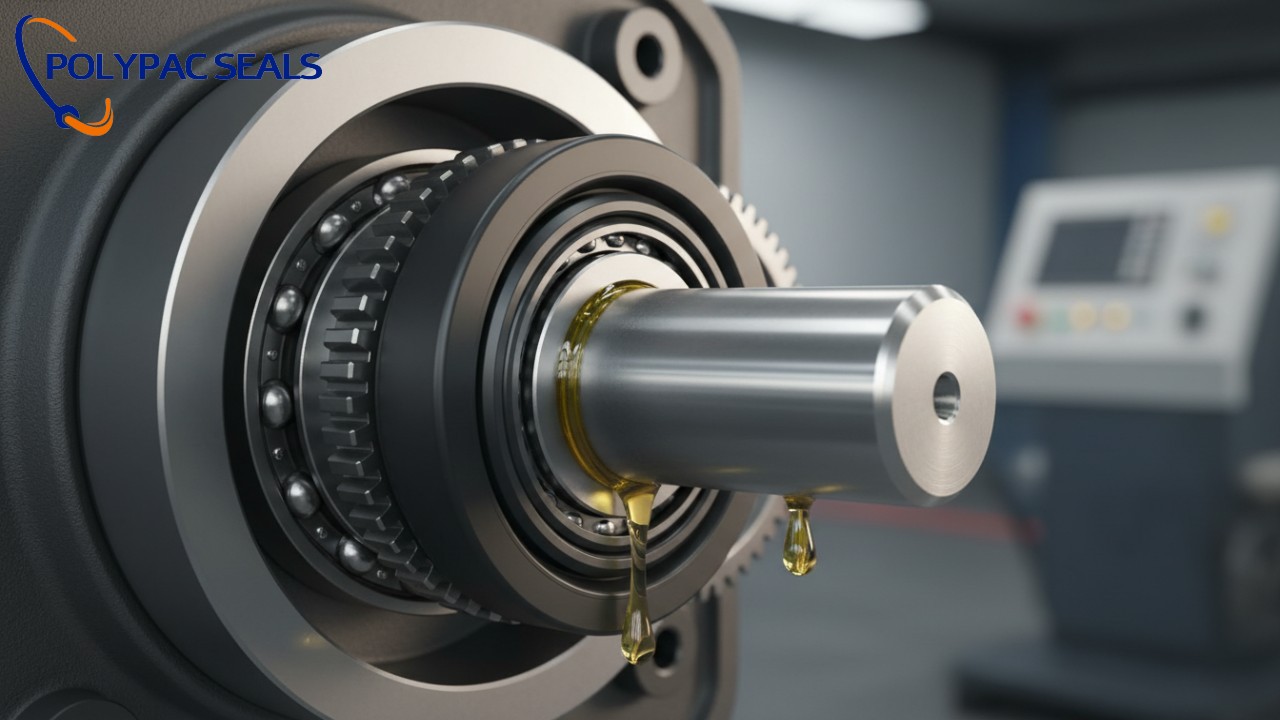
The Physics of Prediction: Beyond PV Limits
Standard Pressure-Velocity (PV) calculations are lagging indicators that define a theoretical maximum but fail to predict real-time tribological heat generation or localized thermal lag.
To predict failure, you must look at viscoelastic hysteresis. This is the lag between the stress applied to the seal (by the rotating shaft) and the material's reaction. At high RPMs, if the shaft has even microscopic runout, the seal material must compress and rebound thousands of times per second. Standard elastomers often fail this "rebound test," acting more like a solid than a flexible barrier. This physical disconnect allows oil to bypass the lip, a phenomenon often mistaken for simple wear.
Why PV Limits Fail at High Speed:
- Thermal Lag: The shaft heats up faster than the housing, expanding and increasing interference (friction) before the seal can relax.
- Lubricant Fling-off: Centrifugal force pushes oil away from the contact zone, creating dry running conditions that PV charts assume are lubricated.
- Vibration Stacking: Minor shaft harmonics amplify heat generation exponentially.
3 Early Warning Signs of Imminent Seal Failure
To implement predictive seal maintenance, you must monitor specific data points that precede physical leakage. These signs often appear 200-500 hours before catastrophic failure.
1. Thermal Spiking (Micro-Fluctuations)
Most systems monitor bulk oil temperature. However, predictive models look for rapid, localized temperature spikes at the seal housing. A steady rise in housing temperature—independent of the system load—indicates that the lubrication film is breaking down and tribological heat generation is entering a critical phase.
2. Vibration Harmonics
A change in the high-frequency vibration signature of the housing often indicates "stick-slip" friction or lip instability. As the seal material hardens, it dampens vibration less effectively, transmitting more shaft noise to the housing sensors.
3. Lubricant Discoloration (The "Coffee Ground" Effect)
Before a seal leaks, it burns. Analyzing the lubricant for microscopic carbon particles (coking) is a definitive leading indicator. If your oil analysis shows suspended carbon black particles, your seal lip is already disintegrating.
Material Science: Choosing for Longevity in 2026
The most effective way to prevent premature failure is selecting materials engineered for hydrodynamic lip geometry and rapid heat transfer, such as filled PTFE compounds rather than standard elastomers.
At Polypac Industrial Technology, we have observed a massive shift away from standard FKM (Viton™) in high-speed electric motor applications. While FKM is chemically robust, it lacks the thermal conductivity of our specialized bronze-filled or carbon-filled PTFE compounds. These fillers act as thermal conduits, pulling heat away from the lip and transferring it to the housing.
Polypac’s High-Speed Material Matrix:
- Carbon-Filled PTFE: Excellent for dry running and high-speed applications where static electricity dissipation is required.
- Bronze-Filled PTFE: High thermal conductivity and compressive strength, ideal for high-pressure, high-speed applications.
- Polymer-Filled PTFE: Offers the lowest coefficient of friction for extreme RPMs where soft shafts are used.
Shaft Dynamics: The Invisible Culprit
Dynamic runout analysis is critical because even a shaft within static tolerance specs can wobble enough at 20,000 RPM to physically lift the seal lip off the surface.
According to standards like ISO 6194-4, maintaining a dynamic runout below 0.05 mm is often required for sealing integrity at high velocities. If the shaft's center of rotation shifts (eccentricity), the seal lip is forced to act as a pump. If the pumping rate of the runout exceeds the hydrodynamic pumping rate of the seal's helix pattern, leakage is instantaneous.
Critical Shaft Parameters for Prediction:
- Surface Texture (Rz vs Ra): A surface that is too smooth (<0.2 µm Ra) cannot retain a lubrication film, while one that is too rough acts as a file. The lead angle must be zero (plunge ground) to prevent pumping oil out.
- Harmonic Vibration: Shafts that resonate at the seal's natural frequency will induce "chatter," destroying the lip in minutes.
Smart Sealing Technology: The Future is Connected
The integration of smart sealing technology involves embedding piezoelectric sensors or thermocouples directly into the seal gland to provide real-time feedback to the PLC.
By 2026, we expect "Smart Seals" to become standard in critical aerospace and EV applications. These systems do not just seal; they report. They monitor the Delta-T (temperature difference) between the process fluid and the seal lip. If the Delta-T widens, the system can automatically adjust motor speed or cooling flow to save the seal.
Expert Tips: Common Mistakes in High-Speed Sealing
Over-Tightening Springs A common reactive fix is to switch to a tighter garter spring to stop a leak. Do not do this. Increasing radial load increases friction linearly but heat generation exponentially. Instead, consider a springless lip design with memory-set PTFE.
Ignoring Housing Expansion Engineers calculate shaft expansion but often forget the housing. If the housing expands more than the seal's outer diameter, the seal will spin in the bore (OD leakage). Ensure your metal case interference fit accounts for the thermal expansion coefficient of the housing material (e.g., aluminum vs. steel).
Surface Finish Neglect Using a shaft with a "directionality" (lead) from turning operations will pump oil past the seal. Always specify plunge grinding or polishing to remove spiral lead marks.
Conclusion
Predicting high-speed rotary seal failure requires looking beyond the spec sheet to the physics of thermodynamics, material response time, and shaft harmonics. By implementing predictive seal maintenance protocols—such as monitoring dynamic runout and thermal spiking—and selecting advanced materials like Polypac’s filled PTFE compounds, you can transform sealing from a maintenance headache into a reliability asset.
Contact Polypac Industrial Technology today to discuss how our customized PTFE solutions can optimize your high-speed applications.


Products
What does "AS568" mean?
Can I reuse a seal?
How can I prevent seal damage during installation?
What is the difference between NBR and FKM materials?
When should I use a spring-energized seal instead of a standard elastomeric seal?
Stay Updated with Industry Insights
Subscribe to our articles and receive the latest news, expert guidance, and technical updates directly in your E-mail.
Rest assured that your privacy is important to us, and all information provided will be handled with the utmost confidentiality.

Polypac is a trusted global supplier of high-performance sealing solutions, providing OEM & ODM services for industries worldwide.
E-mail:
Phone/WhatsApp:
© 2025 Polypac Seals. All Rights Reserved.
dms
DMS
DMS