












Scraper Ring Seals vs. Wiper Seals: The Definitive Comparison for Contamination Control
Hydraulic system failure is costly, and industry data suggests that up to 90% of these failures are caused by fluid contamination. The first line of defense against this threat is the humble exclusion device. However, engineers often confuse the terminology, leading to improper selection and catastrophic contamination ingress prevention failures.
Are you dealing with frozen mud on an excavator or fine dust in a cleanroom? The distinction between a scraper ring seal and a wiper seal is not just semantic—it is the difference between long-term reliability and scored cylinder rods. This guide provides a direct comparison to help you choose the right solution.
What is the Difference Between a Scraper Ring and a Wiper Seal?
A scraper ring seal is a rigid or semi-rigid exclusion device designed to mechanically shear heavy contaminants (ice, tar, and dried mud) from a retracting rod, whereas a wiper seal is a flexible elastomeric component designed to wipe away fine dust and moisture.
While both are hydraulic cylinder exclusion devices, their behaviors differ significantly based on the environment:
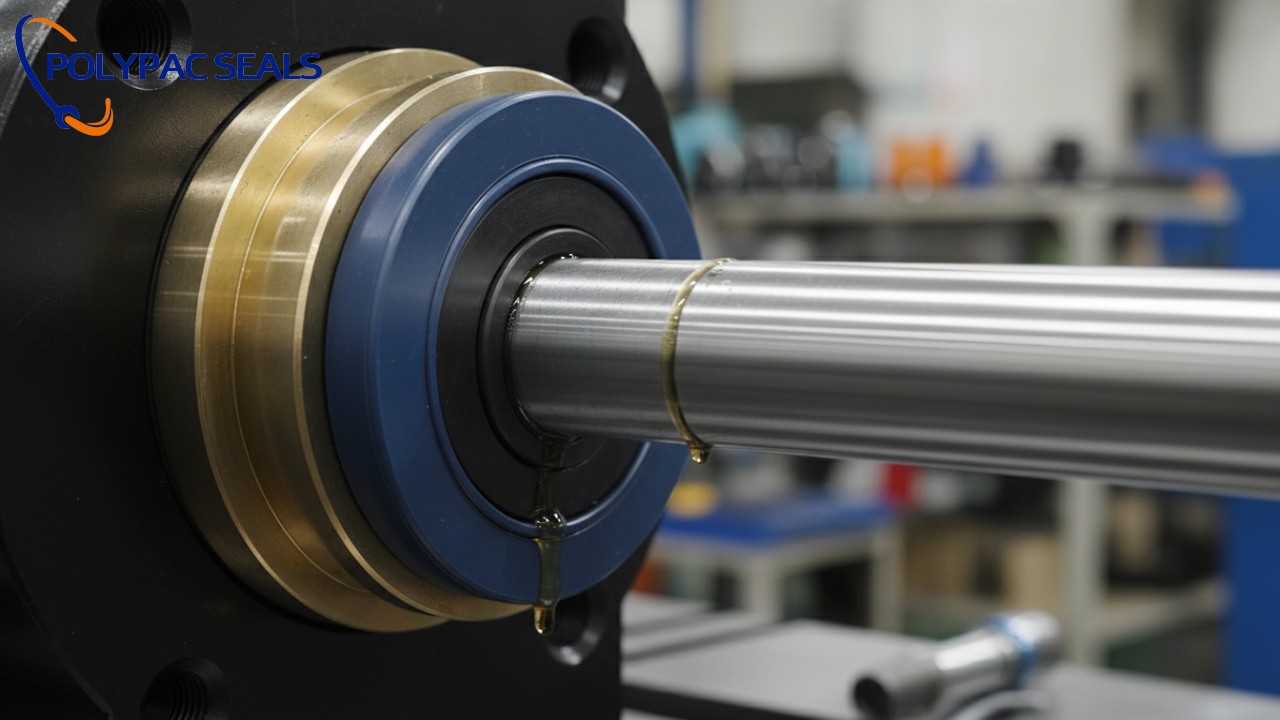
- Scraper Rings (The "Bouncer"): These act as the aggressive primary shield. They are typically made from metals (brass, bronze) or engineering plastics like PEEK and filled PTFE. Their goal is to dislodge debris that has physically bonded to the rod surface.
- Wiper Seals (The "Cleaner"): These are the finishing detailers. Made from softer materials like NBR (nitrile) or polyurethane (PU), they maintain a tight interference fit to block microscopic particles and moisture while retaining a thin oil film on the rod.
- Placement: In heavy-duty applications, a scraper is often placed outermost, followed immediately by a wiper or rod seal to handle the finer particulates.
The Mechanics of Contamination Control: How They Work
Effective exclusion relies on specific rod wiper geometry and profiles to balance the shear force required to remove debris against the friction that generates heat.
To understand the physics of exclusion, consider the "pump-out" effect. Modern sealing systems are designed not just to block ingress but to actively transport residual fluid back into the system on the extension stroke.
Key Mechanisms:
- Shear Force: Metallic scraper rings vs. elastomeric wipers differ here. A metal scraper uses high radial force to "cut" through ice or cement. A rubber wiper would simply deform and ride over such hard debris, allowing it to enter the gland.
- Lip Geometry: Scrapers feature a sharp, negative-rake-angle lip to peel contaminants away. Wipers use a positive-rake angle to slide over the rod while scraping fluid back in.
- The Stack: In severe environments, a "tandem" arrangement is used. The scraper sits at the atmospheric side, protecting the softer rod seal and buffer ring from damage.
Note: According to the International Organization for Standardization (ISO), maintaining fluid cleanliness codes (ISO 4406) is critical. A single particle larger than the dynamic clearance (often <4 microns) can initiate a chain reaction of wear.
Detailed Deep Dive: Scraper Ring Seals (Heavy-Duty)
Scraper rings are best suited for aggressive environment sealing solutions where contaminants can physically adhere to or damage the cylinder rod.
Industries such as mining, forestry, and offshore drilling rely on scrapers because soft rubber cannot withstand the impact of flying rocks or the abrasion of dried concrete. At Polypac, we specialize in manufacturing filled PTFE scrapers (bronze-filled, glass-filled) that bridge the gap between metal durability and plastic flexibility.
Key Features of Scraper Rings:
- Materials: Bronze, brass, stainless steel, PEEK, and virgin/filled PTFE.
- Target Contaminants: Ice, cement, tar, slag, and heavy clay.
- Profiles:
- Single-Acting Metal: A press-fit metal ring that floats on the rod.
- Double-Acting Composite: Features an energizing O-ring to maintain contact even as the scraper wears.
- Risk: If used on soft rods (non-hardened), metal scrapers can cause scoring.
Detailed Deep Dive: Wiper Seals (Light to Medium Duty)
Wiper seals are the standard exclusion choice for factory automation, indoor hydraulics, and light construction equipment where dust and moisture are the primary threats.
These seals rely on the elasticity of the material to follow the side movement (deflection) of the rod. Unlike rigid scrapers, wipers can compensate for slight rod misalignment.
Key Features of Wiper Seals:
- Materials: NBR, FKM (Viton), and High-Performance Polyurethane (PU).
- Target Contaminants: Shop dust, water spray, moisture, and light dirt.
- Design Options:
- Snap-In Wipers: Easy to install into a flexible groove.
- Metal-Cased Wipers: A rubber lip bonded to a metal shell for press-fit stability in open housings.
Comparative Analysis: Metal vs. Plastic Scrapers
Choosing between metallic and plastic designs requires balancing impact resistance against the ability to follow rod deflection.
Engineers often face a trade-off: metal is durable but rigid; plastic is compliant but softer.
Decision Matrix:
- Durability: Metal scrapers excel in high-velocity impact zones (e.g., rock breakers). However, they require a hardened chrome rod surface to prevent damage.
- Flexibility: Plastic (PTFE/PEEK) scrapers are better at sealing rods that bend under load. Polypac’s Bronze-filled PTFE scrapers offer the best of both worlds: high compressive strength and low friction.
- Corrosion: For marine environments, stainless steel or hydrolysis-resistant PU is non-negotiable.
Expert Tips: Selection and Installation Best Practices
Proper gland design and material compatibility are the two most critical factors in preventing seal failure and rod damage.
Even the most expensive seal will fail if installed in an out-of-spec groove. The National Fluid Power Association (NFPA) highlights that improper installation is a leading cause of early hydraulic leaks.
Installation Checklist:
- Check the stick-slip: If a wiper is too dry, it will chatter and squeak. Ensure the rod has a microscopic lubrication film.
- Verify Gland Dimensions: A loose scraper will rotate in the housing, acting like a drill bit against the gland wall.
- Hardness Matching: Never install a steel scraper on a soft stainless steel rod. The scraper is harder than the rod and will score it immediately.
- Chemical Check: If using biodegradable hydraulic fluids (HEES), ensure your wiper material (like FKM or specific PUs) is compatible. Standard NBR may swell and degrade.
Future Trends: Sealing Technology in 2026 and Beyond
The future of sealing lies in smart exclusion devices that can detect ingress in real-time and biocompatible materials that meet stricter environmental regulations.
As Industry 4.0 matures, the "dumb" rubber ring is becoming intelligent.
- Smart Scrapers: Prototypes now exist with embedded conductive sensors that alert operators when the lip is worn or when moisture breaches the barrier.
- Eco-Materials: With the push for green hydraulics, Polypac is actively developing sealing materials compatible with next-generation biodegradable fluids.
- Surface Texturing: New laser-textured rod surfaces require adaptive wiper profiles that can seal against non-smooth finishes without rapid wear.
Conclusion & Call to Action
Selecting the correct exclusion device is a balance of aggression and finesse. Use rigid scraper ring seals for ice and heavy mud, and rely on flexible wiper seals for dust and fluid retention. Correct selection extends cylinder life, reduces downtime, and protects expensive hydraulic pumps from catastrophic failure.
As a leader in sealing material development since 2008, Polypac Industrial Technology Co., Ltd. offers a 10,000-square-meter facility dedicated to crafting custom PTFE, NBR, and FKM solutions for your most demanding applications.
Contact Polypac today to discuss your specific needs and secure your hydraulic systems against contamination.


Products
What is the difference between NBR and FKM materials?
Can I reuse a seal?
When should I use a spring-energized seal instead of a standard elastomeric seal?
What is the purpose of the metal spring in a rotary shaft seal?
What is the difference between a static seal and a dynamic seal?
Stay Updated with Industry Insights
Subscribe to our articles and receive the latest news, expert guidance, and technical updates directly in your E-mail.
Rest assured that your privacy is important to us, and all information provided will be handled with the utmost confidentiality.

Polypac is a trusted global supplier of high-performance sealing solutions, providing OEM & ODM services for industries worldwide.
E-mail:
sales2@dmsseals.com
Phone/WhatsApp:
© 2025 Polypac Seals. All Rights Reserved.
dms
DMS
DMS