












POM: The Complete Guide to Acetal (Polyoxymethylene) Engineering Plastic | Polypac
POM: The High-Performance Engineering Plastic Powering Precision and Durability
In the realm of engineering thermoplastics, few materials offer the combination of strength, stiffness, and low friction as reliably as POM (Polyoxymethylene), commonly known as Acetal or by the trade name Delrin®. This semi-crystalline polymer is a workhorse in precision manufacturing, valued for its excellent dimensional stability, low moisture absorption, and outstanding wear resistance. While not an elastomer for sealing, POM is a critical material in the world of sealing systems and mechanical components, often serving as the rigid, durable backbone that enables other parts to function flawlessly.
At Polypac, with our ISO 9001 & IATF 16949 certified focus on engineered components for demanding systems, we utilize and supply high-performance POM for applications where metal is too heavy, other plastics are too weak, and precision is non-negotiable. This guide explores the properties, benefits, and essential uses of this versatile engineering plastic.
What is POM (Polyoxymethylene)?
POM is a high-strength, rigid thermoplastic known for its excellent balance of mechanical properties. It is manufactured in two main types: the homopolymer (exemplified by Delrin®) and the copolymer. The homopolymer generally offers higher mechanical strength and stiffness, while the copolymer provides better chemical and thermal stability.
In mechanical and fluid power systems, POM is prized for its role in:
-
Precision Mechanical Components: Gears, bearings, rollers, and fasteners requiring tight tolerances.
-
Low-Friction Wear Components: Guide strips, wear rings, and sliding parts in cylinders and linear guides.
-
Structural and Insulating Parts: Housings, clips, and connectors where strength, stiffness, and electrical insulation are needed.
Key Properties and Advantages of POM
POM's property profile makes it a first-choice material for countless engineered parts:
1. High Strength, Stiffness, and Toughness
POM offers an exceptional strength-to-weight ratio, with high tensile strength and rigidity. It maintains good impact resistance and toughness, even at low temperatures.
2. Excellent Dimensional Stability
-
Low Moisture Absorption: POM absorbs very little water (<0.25%), meaning parts retain their precise dimensions in humid or wet environments, unlike many nylons (PA).
-
Low Creep: It resists deformation under continuous load over time, crucial for parts under constant stress.
3. Outstanding Wear and Abrasion Resistance
When paired with its low friction, this property makes POM ideal for moving parts in contact with metals or other polymers. It operates smoothly with minimal lubrication.
4. Low Friction and Good Sliding Properties
It has a low coefficient of friction against both steel and itself, making it excellent for bearings, gears, and wear strips.
5. Good Chemical Resistance
Resistant to a wide range of solvents, oils, greases, and neutral chemicals. However, it is not recommended for strong acids or bases.
6. Easy Machinability and Fabrication
POM can be precision-machined to very tight tolerances with excellent surface finishes. It is also readily injection molded for high-volume production of complex parts.
Common Applications in Engineering and Sealing Systems
POM components are ubiquitous in high-performance machinery:
-
Precision Gears and Bushings: In automotive mechanisms, conveyor systems, and office machinery due to its quiet operation and wear resistance.
-
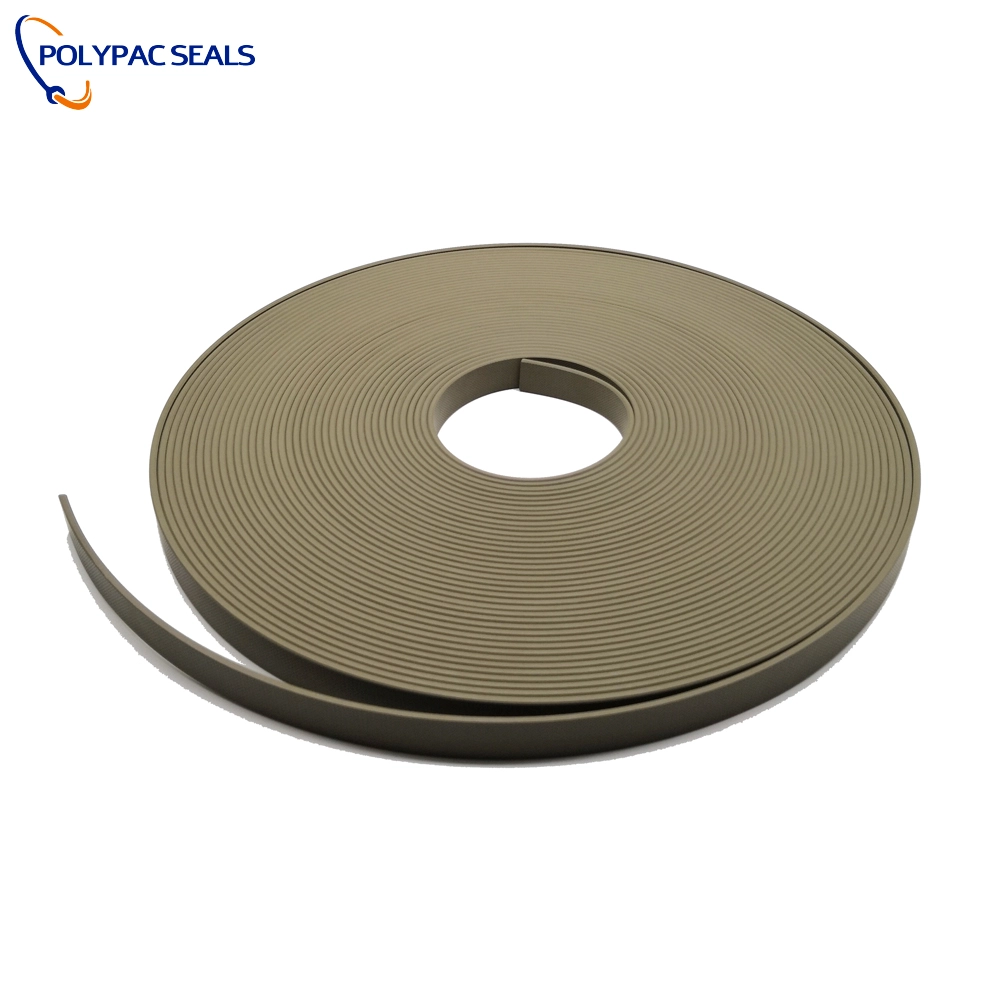
Wear Strips and Guide Rings: Used in hydraulic and pneumatic cylinders as low-friction wear bands or guide strips. They prevent metal-to-metal contact, absorb side loads, and ensure piston/rod alignment, directly protecting the sealing elements.
-
Fasteners and Clips: Lightweight, strong, and resistant to corrosion, making them ideal for automotive interior clips, electrical connectors, and assembly fixtures.
-
Valve and Pump Components: Used for rotors, vanes, and housings in fluid handling equipment where chemical resistance and dimensional stability are key.
-
Consumer Appliances and Electronics: In gears, rollers, and structural parts of printers, cameras, and kitchen appliances.
POM in Sealing and Fluid Power: The Unsung Hero
While POM itself is not a sealing material, it plays several critical supporting roles:
-
Anti-Extrusion Rings/Back-up Rings: In high-pressure hydraulic systems, POM is an excellent material for back-up rings. Its hardness and dimensional stability provide a rigid barrier that prevents softer seals (like O-rings) from extruding into gaps under extreme pressure.
-
Piston and Rod Wear Rings: As mentioned, POM wear rings are essential for cylinder longevity. They guide the piston and rod, absorbing radial loads and ensuring the primary seals (U-cups, rod seals) are not subjected to misalignment, which would cause premature failure.
-
Valve Seats and Inserts: Its dimensional stability and chemical resistance make it suitable for certain static sealing or flow control surfaces in valves.
The Polypac Advantage: Precision from Pellet to Part
Our expertise with POM ensures components perform as intended:
-
Material Grade Selection: We work with various POM grades (homopolymer, copolymer, glass-filled, PTFE-lubricated) to match the specific requirements of hardness, wear, friction, or structural strength.
-
Precision Machining and Fabrication: We specialize in machining POM to exacting blueprints, producing wear rings, custom guides, bushings, and complex components with the tight tolerances necessary for reliable performance in assembled systems.
-
Quality-First Manufacturing: From raw material stock to finished part, we ensure consistency, accuracy, and the high surface finish required for low-friction applications.
Important Considerations and Limitations
-
UV Resistance: Unmodified POM has poor resistance to prolonged UV exposure. For outdoor use, UV-stabilized grades are required.
-
Not for High-Temperatures: Continuous use temperature typically maxes out around 80-100°C (176-212°F). For higher temperatures, PEEK or PTFE may be better choices.
-
Flammability: POM is flammable; flame-retardant grades are available for specific applications.
-
Adhesion: Its low surface energy makes it difficult to bond; mechanical fastening or specialized adhesives are typically used.
Conclusion
POM (Acetal) is a foundational engineering plastic that enables precision, durability, and silent efficiency in countless mechanical systems. Its unique combination of strength, stability, and low-friction wear makes it indispensable for components that must perform reliably over millions of cycles without failure.
For engineers designing everything from intricate gearboxes to robust hydraulic cylinders, specifying high-quality POM components from a trusted manufacturer like Polypac is a strategic decision for long-term reliability and performance.
Need high-precision wear components, gears, or structural parts? Specify the proven performance of POM. Contact Polypac's engineering team today to discuss your component requirements and machining capabilities.


Products
Can I reuse a seal?
What is the purpose of the metal spring in a rotary shaft seal?
What does "AS568" mean?
What is the difference between a static seal and a dynamic seal?
When should I use a spring-energized seal instead of a standard elastomeric seal?
Stay Updated with Industry Insights
Subscribe to our articles and receive the latest news, expert guidance, and technical updates directly in your E-mail.
Rest assured that your privacy is important to us, and all information provided will be handled with the utmost confidentiality.

Polypac is a trusted global supplier of high-performance sealing solutions, providing OEM & ODM services for industries worldwide.
E-mail:
Phone/WhatsApp:
© 2025 Polypac Seals. All Rights Reserved.
dms
DMS
DMS