












Piston Rod Seals: The 2026 Engineering Guide to High-Performance Hydraulic Systems
Quick Summary: Piston Rod Seal Essentials

- Role: The primary defense against hydraulic fluid leakage into the environment.
- 2026 KPIs: Focus on extrusion resistance, low friction coefficients, and predictive maintenance compatibility.
- Selection: Prioritize material compatibility with modern bio-fluids and high-temperature tolerance.
With the global hydraulic seals market valued at approximately $4.81 billion in 2024 and projected to reach over $5 billion by 2025, the demand for precision sealing has never been higher. For engineers and maintenance professionals, understanding the evolution of rod seals is critical to preventing costly downtime. Since 2008, Polypac Industrial Technology Co.,Ltd has been at the forefront of this evolution, utilizing our 10,000-square-meter facility to develop advanced sealing solutions for the world's most demanding industries.
What is a Piston Rod Seal?
A piston rod seal is a dynamic sealing device installed in the hydraulic cylinder head to prevent fluid leakage while the rod is in motion. It acts as a pressure barrier, keeping hydraulic fluid contained within the system while ensuring a thin lubrication film remains on the rod surface.
The Mechanics of Dynamic Sealing Systems
Unlike static seals (like O-rings in a flange), dynamic sealing systems must handle constant motion, friction, and pressure fluctuations. The rod seal is arguably the most critical component in a hydraulic cylinder because it is the only seal that interfaces directly with the external environment. If it fails, fluid leaks out, and contaminants like dust and moisture get in.
At Polypac, we emphasize that a seal's performance isn't just about stopping leaks; it's about managing friction. A perfect seal allows a microscopic layer of oil to pass—just enough to lubricate the rod but not enough to drip.
Key Functions:
- Leakage Prevention: Holding high-pressure fluid inside the cylinder.
- Contamination Blockade: Working with wipers to exclude dirt.
- Friction Management: Minimizing wear on the metal rod.
Rod Seals vs. Piston Seals: Key Technical Differences
The primary difference is that rod seals prevent external leakage (fluid leaving the cylinder), whereas piston seals prevent internal leakage (fluid passing across the piston head). Rod seals are dynamic seals located in the cylinder gland, while piston seals move with the piston assembly.
Why Distinction Matters
Confusing these two leads to catastrophic system failure. Rod seals must handle "drag" pressure and often face higher abrasion from external contaminants. Piston seals, conversely, are responsible for the cylinder's holding power.
Comparison Matrix:
- Location: Rod seals are static in the housing (dynamic rod); Piston seals are dynamic in the housing (move with piston).
- Pressure: Rod seals usually handle one-way pressure; Piston seals often handle double-acting pressure.
- Failure Consequence: Rod failure = messy external leak; Piston failure = loss of lifting power (drift).
Material Science: Choosing the Right Elastomer in 2026
Seal material compatibility is the process of selecting a polymer that chemically resists the hydraulic fluid while mechanically withstanding the system's temperature and pressure range. In 2026, the shift is toward high-modulus materials that resist extrusion.
Polypac's Approach to Material Selection
With over 15 years of R&D, Polypac has refined specific formulations for extreme environments. Our factory specializes in filled PTFE technology, which is essential for reducing friction in high-speed automation.
Top Material Contenders:
- Polyurethane (PU): The industry standard for mobile hydraulics. It offers superior abrasion resistance and toughness.
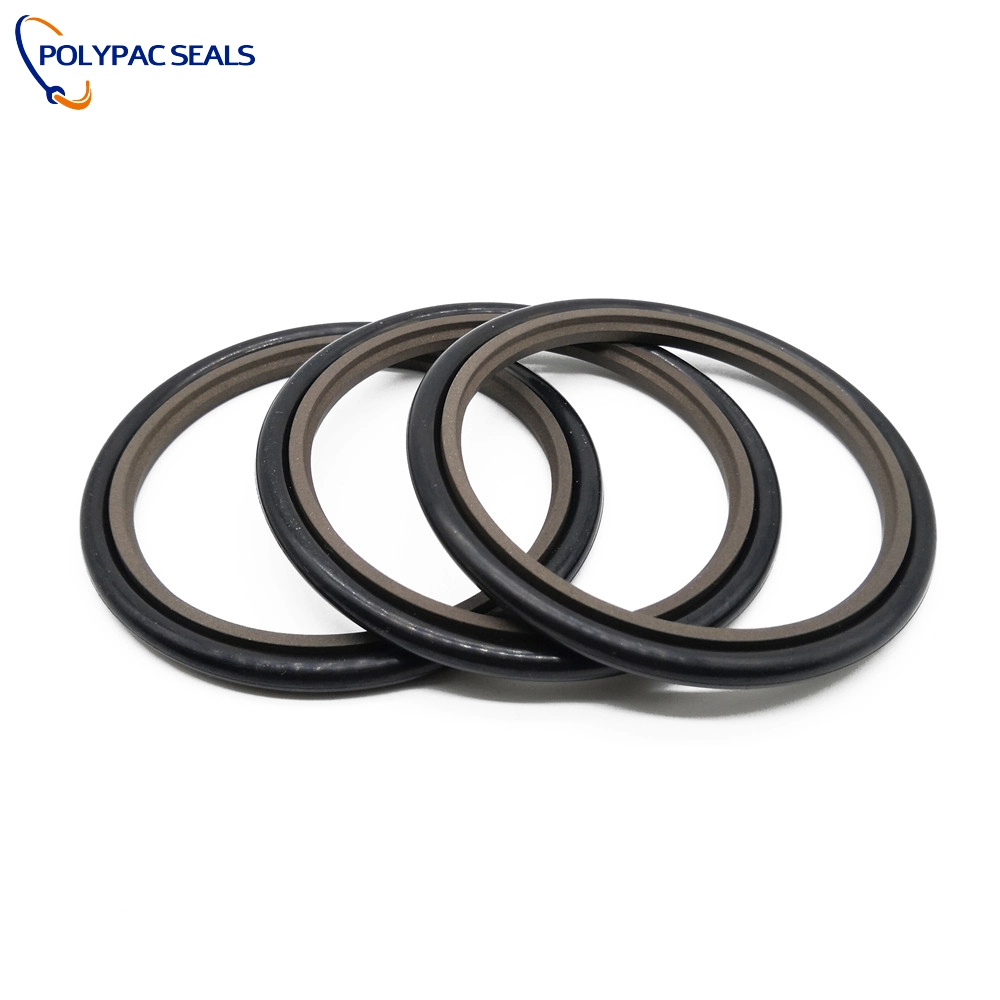
- Filled PTFE: Polypac manufactures Bronze-filled PTFE and Carbon-filled PTFE. These are critical for high-pressure, low-friction applications where "stick-slip" must be eliminated.
- FKM (Viton): Essential for high-temperature applications (>200°C) or aggressive chemical environments.
- NBR (Nitrile): A cost-effective solution for standard industrial applications, though less resistant to ozone than PU.
The Impact of Rod Coatings on Seal Longevity
The hydraulic cylinder lubrication film is a microscopic layer of fluid that rides on the rod surface to prevent direct rubber-to-metal contact. The thickness of this film is determined by the seal design, rod speed, and the surface finish (roughness) of the rod coating.
Balancing Leakage and Lubrication
If the seal is too aggressive, it wipes the rod bone-dry, leading to friction, heat generation, and seal burn. If it's too loose, the system leaks. Modern manufacturing techniques, such as those used at Polypac's 8,000 sqm production floor, ensure seal lips are precision-cut to maintain this delicate balance.
Surface Finish Factors:
- Chrome Plating: The traditional standard. Requires a specific Ra (Roughness Average) to hold oil.
- Ceramic Coatings: harder and smoother, requiring specialized seal materials like filled PTFE to generate a film.
- Stick-Slip: When the film breaks down, the seal "grabs" the rod, causing vibration. This is solved by using low-friction materials like Polypac's MoS₂-filled PTFE.
Expert Troubleshooting: Why Rod Seals Fail
The most common cause of rod seal failure is extrusion, where high pressure forces the seal material into the gap between the rod and the cylinder head. This "nibbling" destroys the seal's structural integrity.
The Cost of Failure
According to recent 2024 data from IoT Analytics, the median cost of unplanned downtime in heavy industries now exceeds $100,000 per hour. This underscores the ROI of investing in high-quality seals with high extrusion resistance.
Diagnostic Checklist:
- Extrusion: Look for "nibbled" or shaved edges on the low-pressure side.
- Fix: Use tighter tolerances or install back-up rings.
- Heat Hardening: The seal cracks and crumbles like coal.
- Fix: Switch to FKM or high-temp PU.
- Scoring: Vertical scratches on the seal lip.
- Fix: Check for rod wiper integration failure; contaminants are entering the system.
- Chemical Attack: The seal swells or turns to jelly.
- Fix: Verify fluid compatibility (e.g., bio-oils attacking NBR).
Future Trends: Smart Seals and Predictive Maintenance
Smart seals are the integration of IoT sensors directly into the sealing architecture to monitor wear, temperature, and pressure in real-time. With the global predictive maintenance market expected to grow from $12.3 billion in 2024 to over $16 billion in 2025, this technology is rapidly moving from concept to reality.
The Shift to Data-Driven Sealing
By 2026, high-end hydraulic cylinders will not just pump fluid; they will transmit data. Polypac is closely monitoring these trends to align our material development with smart sensor integration.
Emerging Technologies:
- Embedded Wear Sensors: Alerting operators when the seal lip has worn down by 80%.
- Pressure Spike Detection: Identifying hydraulic hammers that are invisible to standard gauges.
- Self-Lubricating Polymers: Advanced PTFE blends that release lubricants over time to extend service life in dry-run conditions.
References


Products
How important is surface finish on the metal parts that contact the seal?
What is the purpose of the metal spring in a rotary shaft seal?
What is the difference between NBR and FKM materials?
How can I prevent seal damage during installation?
Why did my O-ring fail prematurely?
Stay Updated with Industry Insights
Subscribe to our articles and receive the latest news, expert guidance, and technical updates directly in your E-mail.
Rest assured that your privacy is important to us, and all information provided will be handled with the utmost confidentiality.

Polypac is a trusted global supplier of high-performance sealing solutions, providing OEM & ODM services for industries worldwide.
E-mail:
Phone/WhatsApp:
© 2025 Polypac Seals. All Rights Reserved.
dms
DMS
DMS